Retatrutide Side Effects: What the Trials Show
Across published phase 2 and phase 3 trials, the most common side effects of retatrutide were gastrointestinal, mainly nausea and diarrhoea, and they were more frequent at higher doses. Trials also reported dose-dependent heart rate increases, more low blood pressure and skin-sensation changes than placebo in one phase 3 trial, and no severe hypoglycaemia in the type 2 diabetes trials. Retatrutide is investigational and not FDA-approved.
01 — What retatrutide is
Retatrutide (LY3437943) is an investigational once-weekly injectable from Eli Lilly that activates three hormone receptors: GIP, GLP-1 and glucagon. It is not approved by the FDA for any use, so everything known about its side effects comes from clinical trials run by its maker.
Each trial below enrolled a different group of people, for a different length of time. We report every figure next to the trial and population it came from, and the numbers from separate trials should not be compared with one another. The REGEN retatrutide library page has compound-level background, and our explainer on how retatrutide works covers its mechanism.
02 — Gastrointestinal effects in adults with obesity
In a 48-week phase 2 trial of 338 adults with obesity, the most common adverse events in the retatrutide groups were gastrointestinal. These events were dose-related, were mostly mild to moderate in severity, and were partially mitigated with a lower starting dose in that trial.
In the 80-week phase 3 TRIUMPH-1 trial, 2,339 adults with obesity without diabetes were randomized to retatrutide or placebo, and the most common adverse events were gastrointestinal.
The TRIUMPH-1 abstract does not give rates for individual symptoms such as nausea or diarrhea.
03 — Nausea and diarrhea in obesity with type 2 diabetes
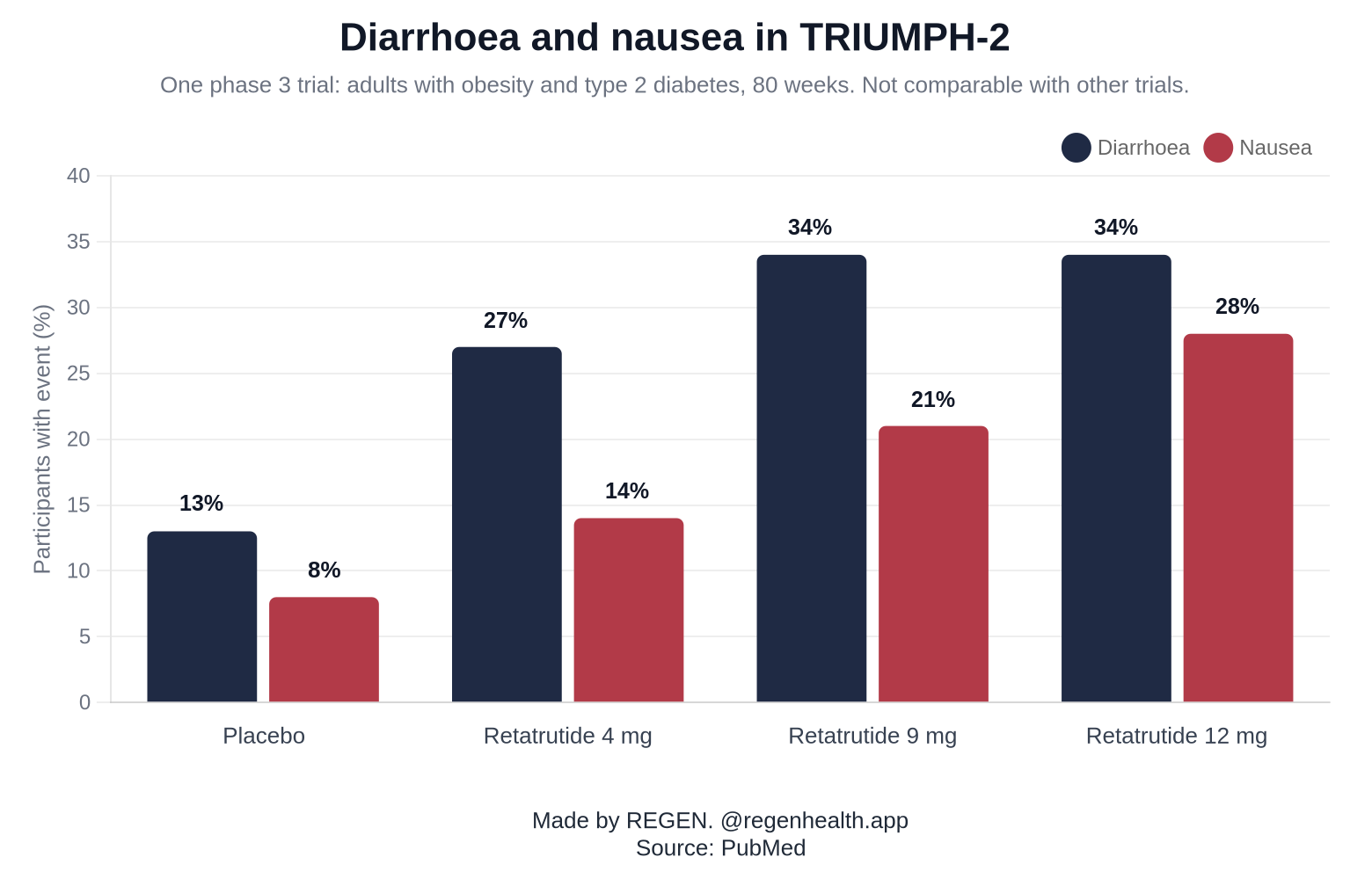
The phase 3 TRIUMPH-2 trial followed 1,152 adults with obesity and type 2 diabetes for 80 weeks. Gastrointestinal events were the most frequently reported adverse events and were more common with retatrutide than with placebo.
In this trial, diarrhoea occurred in 27% of participants in the 4 mg group, 34% in the 9 mg group and 34% in the 12 mg group, compared with 13% in the placebo group. Nausea occurred in 14%, 21% and 28% of the three retatrutide groups, compared with 8% on placebo.
04 — Low blood pressure and skin-sensation changes
TRIUMPH-2 also reported two less familiar effects. Hypotension (low blood pressure) and dysesthesia were more frequent with retatrutide than with placebo. Dysesthesia is an altered or unpleasant sensation, such as tingling or burning, on the skin.
In TRIUMPH-2, hypotension was reported in 1%, 5% and 6% of the 4 mg, 9 mg and 12 mg groups, compared with under 1% on placebo. Dysesthesia was reported in 4%, 6% and 7% of those groups, compared with 1% on placebo.
05 — How many people stopped because of side effects
In TRIUMPH-2, permanent treatment discontinuation due to adverse events or death was more frequent with the 9 mg (12%) and 12 mg (8%) doses than with the 4 mg dose (4%) or placebo (5%). The trial's authors judged the deaths that occurred to be unrelated to the study drug.
In the 40-week phase 3 TRANSCEND-T2D-1 trial of 537 adults with type 2 diabetes managed with diet and exercise alone, the most frequent adverse events with retatrutide were generally mild to moderate gastrointestinal events, which subsided over time. In that trial, study discontinuations due to adverse events were 2-5% with retatrutide and 0% with placebo.
06 — Heart rate
In the 48-week phase 2 trial of adults with obesity, retatrutide raised heart rate in a dose-dependent way. Those dose-dependent increases in heart rate were greatest at 24 weeks and declined thereafter, according to the trial report.
The abstract does not say whether heart rate returned fully to its starting level, and longer-term heart outcomes have not yet been reported in the published trial abstracts.
07 — Low blood sugar in type 2 diabetes trials
Low blood sugar is a common question for drugs used in type 2 diabetes. In a 36-week phase 2 trial of 281 adults with type 2 diabetes in the USA, there were no reports of severe hypoglycaemia and no deaths during the study.
In the same phase 2 trial, mild-to-moderate gastrointestinal adverse events, including nausea, diarrhoea, vomiting and constipation, were reported in 35% of participants in the retatrutide groups, compared with 13% in the placebo group.
In the separate 40-week phase 3 TRANSCEND-T2D-1 trial of adults with type 2 diabetes, no severe hypoglycaemia was reported.
08 — What pooled analyses add, and what is unknown
A 2024 meta-analysis pooled the earlier placebo-controlled phase 2 trials in people with overweight, obesity or type 2 diabetes. It found retatrutide was associated with an increase in non-severe gastrointestinal and hypersensitivity adverse events compared with placebo.
All of these trials were funded by Eli Lilly and lasted 80 weeks or less. Products sold online outside of trials are not the studied drug, are not approved, and their contents are unverified, so trial safety data do not describe them. The REGEN page on retatrutide side effects keeps a running summary, and our guide to how we grade the evidence explains how we weigh industry-funded trials.
If you are researching retatrutide, REGEN, our peptide research app, lets you look it up and get answers drawn from cited research like the trials above. You can also log lab results from your clinician as dated entries, so they sit on one timeline next to the research they relate to.
FAQ
What are the most common side effects of retatrutide?
Gastrointestinal events such as nausea and diarrhoea were the most common adverse events in the published retatrutide trials. In the phase 3 TRIUMPH-2 trial of adults with obesity and type 2 diabetes, diarrhoea occurred in 27% to 34% of the retatrutide groups, compared with 13% on placebo.
Does retatrutide raise heart rate?
In a 48-week phase 2 trial of adults with obesity, retatrutide caused dose-dependent increases in heart rate that were greatest at 24 weeks and declined afterward. Longer-term heart outcomes have not been reported in the published abstracts.
Does retatrutide cause low blood sugar?
In two trials of adults with type 2 diabetes, a 36-week phase 2 trial and the 40-week phase 3 TRANSCEND-T2D-1 trial, no severe hypoglycaemia was reported.
Is retatrutide FDA approved?
No. Retatrutide is an investigational drug from Eli Lilly that is still being studied in clinical trials and has no FDA approval for any use.