Sermorelin vs Ipamorelin: What the Data Shows
Sermorelin and ipamorelin both trigger growth hormone release, but through different receptors, and no clinical trial has compared them head to head. Sermorelin's data come mainly from children with growth hormone deficiency and healthy older men; ipamorelin's come from healthy male volunteers and adults recovering from bowel surgery, so their numbers describe different people and are not interchangeable.
01 — Two receptors, no head-to-head trial
Sermorelin and ipamorelin both prompt the pituitary to release growth hormone, but they act on different receptors, and no published trial has compared them directly. Sermorelin is a growth hormone-releasing hormone (GHRH) analog; ipamorelin is a growth hormone secretagogue that acts on the ghrelin receptor.
A 2026 review in Frontiers in Endocrinology places sermorelin among the GHRH analogues and ipamorelin among the growth hormone secretagogues, two separate classes of peptides that act on the GH-IGF-1 axis. Any comparison therefore has to set separate studies side by side and keep each result tied to the people it was measured in.
Sermorelin corresponds to the first 29 amino acids of human GHRH, which is why older trials call it GHRH(1-29), and it was once sold as Geref. Ipamorelin is a five-amino-acid peptide that Novo Nordisk researchers described in 1998 as the first selective growth hormone secretagogue. Compound-level background is on the REGEN Sermorelin library page and the Ipamorelin library page.
02 — Sermorelin: children with GH deficiency and older men
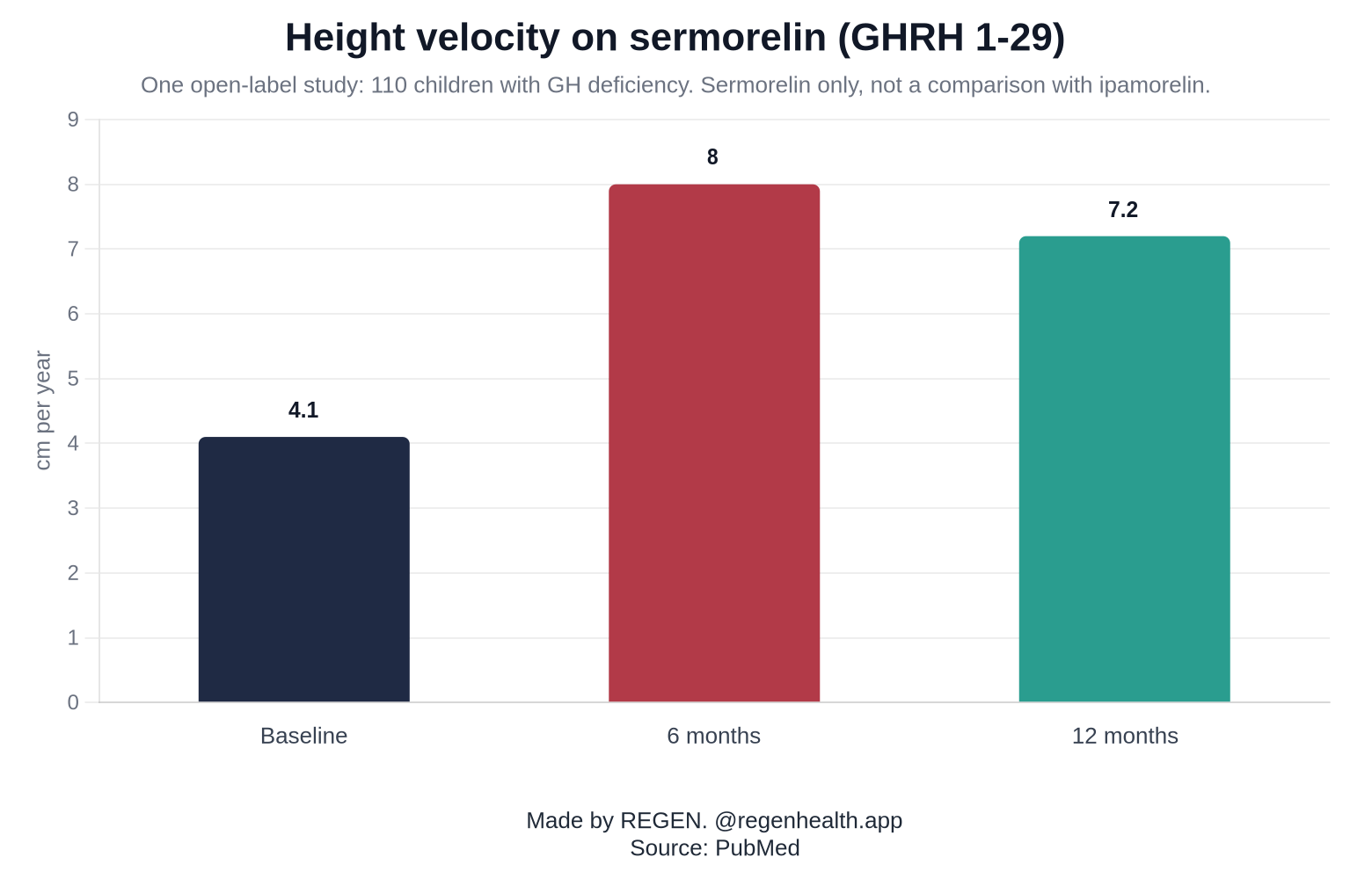
Sermorelin's human data come mainly from children with growth hormone deficiency and from healthy older men. In an open-label multicenter study of 110 previously untreated prepubertal children with growth hormone deficiency, once-daily GHRH(1-29) at bedtime was followed by a rise in mean height velocity from 4.1 cm per year at baseline to 8.0 cm per year at 6 months and 7.2 cm per year at 12 months.
In 11 healthy men aged 64 to 76 with low baseline IGF-I, nightly 2 mg GHRH(1-29) injections for 6 weeks increased mean nocturnal growth hormone release, with no change in IGF-I and no DEXA-measured change in muscle or fat. That study compared each man with his own starting values and had no placebo group.
Geref (sermorelin acetate) was approved by the FDA in 1997 for idiopathic growth hormone deficiency in children with growth failure. Its maker discontinued it in 2008, and in 2013 the FDA determined the product was not withdrawn for reasons of safety or effectiveness.
03 — Ipamorelin: healthy volunteers and surgical patients
The main published human data for ipamorelin are a short pharmacology study and one phase 2 trial. In healthy men given intravenous infusions at five dose levels, eight men per level, ipamorelin produced a single episode of growth hormone release that peaked at 0.67 hours, and its terminal half-life was 2 hours.
In a multicenter, double-blind phase 2 trial in 114 adults recovering from bowel resection, intravenous ipamorelin twice daily for up to 7 days did not significantly shorten the time to the first tolerated meal compared with placebo. The median times were 25.3 and 32.6 hours (p = 0.15).
The selective label comes from animal work. In conscious swine, ipamorelin did not raise ACTH or cortisol beyond the levels seen after GHRH, even at doses more than 200-fold higher than those needed for half-maximal GH release. The two human studies above did not report cortisol results in their abstracts.
04 — Side by side, with populations attached
Set next to each other, these studies measured different things in different people, so their results cannot be ranked. The list below keeps each figure attached to its own study, and none of the figures came from a direct comparison of the two peptides.
The sermorelin studies tracked height growth and overnight GH secretion over weeks to months, while the ipamorelin studies measured the GH response to a single infusion or the return of bowel function after surgery. Because the doses, routes and participants all differ, these results are not comparable and do not show which compound is stronger. Earlier REGEN comparisons of Sermorelin vs CJC-1295 and CJC-1295 vs Ipamorelin take the same approach.
- Sermorelin (GHRH 1-29), 110 children with GH deficiency, 12 months, open-label: height velocity 7.2 cm per year versus 4.1 at baseline.
- Sermorelin (GHRH 1-29), 11 healthy men aged 64 to 76, 6 weeks, no placebo group: more nocturnal GH release, no change in IGF-I or body composition.
- Ipamorelin, healthy men, single intravenous infusion at five dose levels: one GH release episode peaking at 0.67 hours.
- Ipamorelin, 114 adults after bowel resection, up to 7 days, placebo-controlled: no significant difference in time to first tolerated meal.
- Ipamorelin, conscious swine: no ACTH or cortisol rise beyond GHRH levels. Animal data, not human.
- Head-to-head trial of sermorelin versus ipamorelin: none published.
05 — Safety findings reported in the studies
Each study reported safety only for its own participants, and none was designed to detect rare or long-term harms. In the bowel-surgery trial, treatment-emergent adverse events occurred in 87.5% of the ipamorelin group and 94.8% of the placebo group, and the authors described ipamorelin as well tolerated over up to 7 days.
The children's sermorelin study reported no adverse changes in general biochemical or hormonal analyses and no change in fasting glucose over the first year. The study in older men reported no significant adverse effects over its 6 weeks.
Looking at the wider group of GH-axis peptides, the 2026 review lists reported adverse effects including prolactin and cortisol elevations, appetite changes, dysglycaemia, fluid retention and injection-site reactions. Those effects are described for the peptide classes as a group, not measured for sermorelin or ipamorelin alone.
06 — Regulatory and sport context
Both peptide classes appear on the World Anti-Doping Agency's prohibited list, and anti-doping laboratories have built urine tests for each. One method detected sermorelin, tesamorelin and two forms of CJC-1295 at limits of 1 ng/ml or less in fortified urine.
A separate study identified ipamorelin metabolites in urine after nasal administration to a single volunteer, and its authors added those metabolites to a routine screening procedure.
The 2026 review notes the absence of regulatory approval for physique- or performance-related indications for these peptides, and uncertainty about product composition and dose in unregulated supply chains.
If you are comparing the two, REGEN, our peptide research app, lets you look up sermorelin and ipamorelin and get answers drawn from cited research like the studies above. You can also log lab results such as IGF-I as dated entries, so values ordered by your clinician sit on one timeline next to the research they relate to.
FAQ
Is there a head-to-head trial of sermorelin vs ipamorelin?
No. No published trial has compared the two directly. Sermorelin, studied as GHRH(1-29), was tested mainly in children with growth hormone deficiency and in healthy older men, while ipamorelin's human studies enrolled healthy male volunteers and adults recovering from bowel surgery, so their results cannot be ranked against each other.
What is the difference between sermorelin and ipamorelin?
They act on different receptors. Sermorelin is an analog of growth hormone-releasing hormone and works through the GHRH receptor, while ipamorelin is a growth hormone secretagogue that works through the ghrelin receptor. A 2026 review places them in separate peptide classes.
Is ipamorelin stronger than sermorelin?
The published evidence cannot answer that. Ipamorelin's GH response was measured after single infusions in healthy men, and sermorelin's overnight GH change was measured in 11 older men over 6 weeks. Those are different people, doses and routes, so the results are not comparable.
Is sermorelin FDA approved?
Sermorelin was approved as Geref (sermorelin acetate) in 1997 for idiopathic growth hormone deficiency in children with growth failure. Its maker discontinued Geref in 2008 and the FDA withdrew the approval effective June 2009. In 2013 the FDA determined it had not been withdrawn for reasons of safety or effectiveness.