Tesamorelin vs Sermorelin: What the Data Shows
Tesamorelin and sermorelin are both GHRH analogs, but no clinical trial has compared them head to head. Tesamorelin's data come from adults with HIV and abdominal fat accumulation; sermorelin's come mainly from healthy older men and children with growth hormone deficiency, so their reported numbers describe different people and are not interchangeable.
01 — Two GHRH analogs, no head-to-head trial
Tesamorelin and sermorelin are both synthetic analogs of growth hormone-releasing hormone (GHRH), the hypothalamic signal that prompts the pituitary to release growth hormone. No published trial has compared them directly, so any comparison has to set separate studies side by side and keep each result tied to the people it was measured in.
Sermorelin corresponds to the first 29 amino acids of human GHRH, which is why older trials report it as GHRH(1-29). Tesamorelin is sold under the brand name Egrifta, and its main trials enrolled a very different population from the sermorelin studies, as the sections below show.
Laboratory research groups the two together: a 2021 analytical study described sermorelin and tesamorelin as two of the larger GHRH synthetic analogs, alongside CJC-1295 and CJC-1295 with drug affinity complex. Readers who want compound-level background can start with the REGEN Tesamorelin library page and the Sermorelin library page.
02 — Tesamorelin: trials in adults with HIV
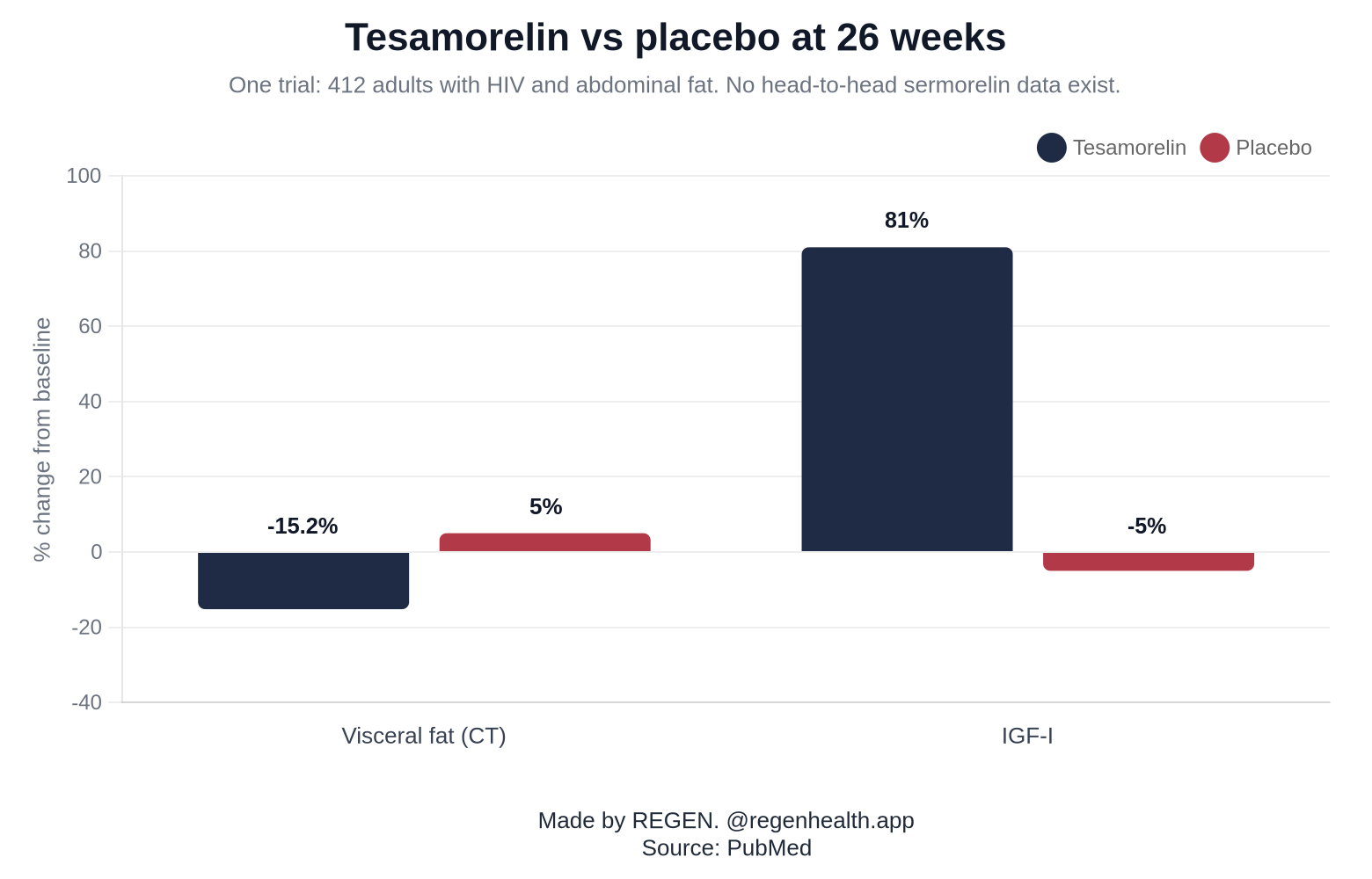
Tesamorelin's human evidence comes mainly from adults with HIV who had accumulated abdominal fat during antiretroviral therapy. In a randomized, placebo-controlled trial of 412 such patients, 86% of them men, daily tesamorelin 2 mg for 26 weeks reduced visceral adipose tissue by 15.2%, while it increased by 5.0% in the placebo group.
In the same trial, IGF-I rose by 81.0% in the tesamorelin group and fell by 5.0% with placebo. More participants in the tesamorelin group withdrew because of an adverse event, and glycemic measures did not differ significantly between the groups.
A smaller 2014 trial in 50 antiretroviral-treated adults with HIV and abdominal fat accumulation reported reductions in visceral fat and liver fat over 6 months compared with placebo, and its authors described the liver-fat change as modest and preliminary.
A 2019 trial in 61 people with HIV and non-alcoholic fatty liver disease reported a 37% relative reduction in hepatic fat fraction from baseline compared with placebo after 12 months. These three trials describe outcomes in people with HIV; they do not show what tesamorelin does in other groups.
03 — Sermorelin: older men and children
Sermorelin's human data are older and drawn from different groups. In 11 healthy men aged 64 to 76 with low baseline IGF-I, nightly GHRH(1-29) injections for 6 weeks increased mean nocturnal growth hormone release, with no change in IGF-I and no DEXA-measured change in muscle or fat.
In an open-label multicenter study of 110 previously untreated prepubertal children with growth hormone deficiency, once-daily GHRH(1-29) at bedtime was followed by a rise in mean height velocity from 4.1 cm per year at baseline to 8.0 cm per year at 6 months and 7.2 cm per year at 12 months.
Some figures often quoted for sermorelin come from a related molecule. In 19 healthy older adults, 16 weeks of nightly [Nle27]GHRH(1-29)-NH2, a norleucine-substituted analog, increased 12-hour integrated GH secretion by 107% in men and 70% in women and serum IGF-I by 28%. Because that molecule is not identical to sermorelin, these results describe a close analog rather than sermorelin itself.
04 — Side by side, with populations attached
Set next to each other, these studies measured different endpoints in different people, which is why their results cannot be ranked against one another. The list below keeps every figure attached to its trial population, and none of the figures came from a direct comparison between the two compounds.
The populations differ in age, health status and reason for treatment, and the trials used different doses, schedules and durations. An IGF-I change measured in adults with HIV and one measured in healthy older adults given a modified analog come from two separate experiments, so neither figure says which compound is stronger. Earlier REGEN comparisons of Tesamorelin vs Ipamorelin and Sermorelin vs CJC-1295 follow the same approach.
- Tesamorelin, 412 adults with HIV and abdominal fat, 26 weeks, placebo-controlled: visceral fat down 15.2% (placebo up 5.0%) and IGF-I up 81.0% (placebo down 5.0%).
- Tesamorelin, 61 people with HIV and fatty liver disease, 12 months, placebo-controlled: hepatic fat fraction 37% below baseline in relative terms.
- Sermorelin (GHRH 1-29), 11 healthy men aged 64 to 76, 6 weeks: more nocturnal GH release, no change in IGF-I or body composition.
- Sermorelin (GHRH 1-29), 110 children with GH deficiency, 12 months, open-label: height velocity 7.2 cm per year versus 4.1 at baseline.
- [Nle27]GHRH(1-29)-NH2, 19 healthy older adults, 16 weeks: IGF-I up 28%. A modified analog, not sermorelin.
- Head-to-head trial of tesamorelin versus sermorelin: none published.
05 — Safety findings reported in the trials
Each trial reported safety findings for its own population only. In the 2014 trial of adults with HIV, fasting glucose was higher with tesamorelin than with placebo at 2 weeks, a mean change of 9 mg/dL versus 2 mg/dL, and the difference was not significant across time points by 6 months.
In the 2019 fatty-liver trial, changes in fasting glucose and glycated haemoglobin did not differ between groups at 12 months, while localised injection-site complaints were more common with tesamorelin, though none were judged serious.
The sermorelin studies reported fewer safety details. The children's study reported no adverse changes in general biochemical or hormonal analyses and no change in fasting glucose over the first year.
The study in older men reported no significant adverse effects over its 6 weeks. None of these studies was designed to detect rare or long-term harms.
06 — Regulatory and sport context
GHRH and its synthetic analogs are prohibited by the World Anti-Doping Agency, and laboratories have built urine tests aimed at them. A 2021 study developed a liquid chromatography-tandem mass spectrometry method that detected sermorelin, tesamorelin and two forms of CJC-1295 at limits of 1 ng/ml or less in fortified urine.
A 2026 narrative review in Sports Medicine lists tesamorelin (Egrifta) and sermorelin among peptides marketed directly to patients, and notes that rigorous human safety data are scarce for many of the unapproved peptides it covers.
If you are comparing the two, REGEN, our peptide research app, lets you look up tesamorelin and sermorelin and get answers drawn from cited research like the studies above. You can also log lab results such as IGF-I and fasting glucose as dated entries, so values ordered by your clinician sit on one timeline next to the research they relate to.
FAQ
Is there a head-to-head trial of tesamorelin vs sermorelin?
No. No published trial has compared the two directly. Tesamorelin's main trials enrolled adults with HIV and abdominal fat accumulation, while sermorelin, studied as GHRH(1-29), was tested mainly in healthy older men and in children with growth hormone deficiency, so their results cannot be ranked against each other.
What is better for fat-loss, sermorelin or tesamorelin?
The published evidence cannot answer that as asked. In adults with HIV and abdominal fat accumulation, a tesamorelin trial reported a 15.2% decrease in visceral fat over 26 weeks versus a 5.0% increase with placebo. A sermorelin study in 11 healthy older men found no DEXA-measured change in fat over 6 weeks. Different populations and designs mean these are not a comparison.
Will tesamorelin make you stronger?
The tesamorelin trials summarised here measured visceral fat, liver fat, IGF-I and glucose in adults with HIV, not muscle strength. In a separate small study of 11 healthy older men, sermorelin (GHRH 1-29) was associated with better scores on two of six strength measures after 6 weeks, a result that has not been tested against tesamorelin.
Is the 28% IGF-I figure for sermorelin?
Not exactly. That figure comes from 19 healthy older adults given [Nle27]GHRH(1-29)-NH2, a norleucine-substituted analog of the sermorelin sequence. It describes a closely related molecule, and a study of sermorelin itself in 11 older men found no change in IGF-I.