What is the half-life of MK-677? Metabolism and Risks
MK-677 is an orally active ghrelin receptor agonist with a half-life of approximately 24 hours. While clinical data demonstrates its ability to stimulate pulsatile growth hormone release and reverse negative nitrogen balance, this sustained activation carries significant metabolic tradeoffs. Managing the resulting hyperinsulinemia requires rigorous surveillance of fasting insulin and HbA1c alongside IGF-1 levels.
01 — The continuous metabolic baseline
MK-677 is a non-peptide ghrelin receptor agonist characterized by a half-life of approximately 24 hours. Because the compound is not FDA-approved for human use and is sold for research purposes only, understanding its sustained pharmacokinetic profile is critical for evaluating its systemic effects. This prolonged duration ensures continuous receptor activation without a refractory period, fundamentally differentiating it from endogenous physiological signaling.
Sustained ghrelin agonism alters the metabolic baseline permanently during the period of administration. The continuous signaling forces a hyper-anabolic state that requires rigorous biomarker surveillance to prevent long-term pancreatic strain. Managing this physiological shift demands routine monitoring of fasting insulin, HOMA-IR, and HbA1c alongside any changes in growth hormone parameters to detect early signs of metabolic distress.
02 — Reversing negative nitrogen balance
One of the primary physiological responses to sustained ghrelin agonism is significant protein conservation under metabolic stress. In a clinical trial setting, MK-677 25 mg daily reversed diet-induced negative nitrogen balance, resulting in a mean nitrogen balance of 0.31 +/- 0.21 g/day compared to -1.48 +/- 0.21 g/day for placebo. This reversal demonstrates profound systemic effects under severe caloric restriction.
Interpreting these nitrogen retention markers requires looking at the broader endocrine environment rather than isolated metrics. A published case report analyzing how LGD-4033 and MK-677 use impacts body composition, circulating biomarkers, and skeletal muscle androgenic hormone and receptor content highlights the complex adaptations driven by such protocols. The addition of synthetic androgens significantly complicates the overall metabolic burden.
03 — Measuring prolonged IGF 1 elevation
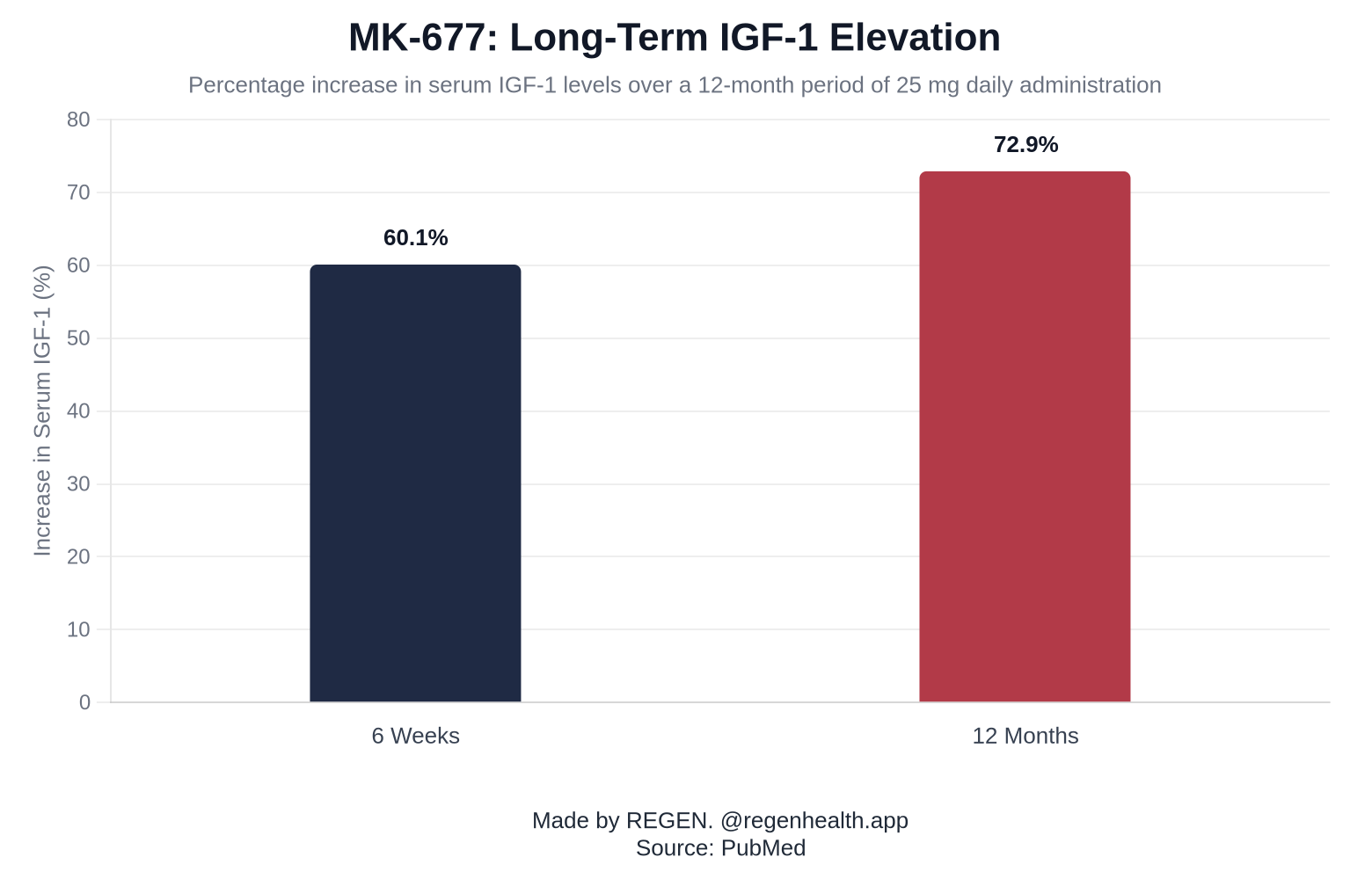
The continuous receptor activation from the extended half-life drives progressive, long-term increases in systemic growth factors. Clinical research shows that administration of MK-677 25 mg resulted in a 60.1% increase in serum IGF-1 levels at 6 weeks and a 72.9% increase at 12 months. This predictable climb demonstrates the compound's potency over an extended duration.
Such substantial and sustained elevations in insulin-like growth factor 1 underline why this is not a short-acting tool. The persistent upward trajectory of IGF-1 over a twelve-month period confirms that the metabolic baseline shifts heavily during administration. High serum IGF-1 correlates with the anabolic benefits but acts as a primary driver of the associated metabolic trade-offs.
04 — Insulin resistance and pancreatic strain
The critical trade-off of maintaining continuously elevated growth hormone and IGF-1 levels is a progressive decline in systemic insulin sensitivity. As the body manages the uninterrupted signaling, it enters a state of hyperinsulinemia long before changes register on a standard scale. This pancreatic strain makes fasting insulin and HOMA-IR essential tracking metrics to preempt long-term metabolic damage.
When introducing other compounds into a protocol, the metabolic burden multiplies rapidly. Peptides that affect insulin sensitivity or body composition, such as Tesamorelin, operate through different half-lives and receptor affinities. They require distinct monitoring approaches to avoid compounding the risk of systemic insulin resistance and overburdening the pancreas during a prolonged cycle.
05 — Impact on bone turnover markers
Extended ghrelin receptor activation accelerates bone remodeling rapidly during the initial phases of exposure. In clinical observations, treatment with 10 mg and 25 mg of MK-677 for 2 weeks increased mean urine N-telopeptide cross-links by 10% and 17%, respectively, compared to placebo. This identifies a clear dose-dependent response in bone metabolism.
N-telopeptide serves as a highly specific biomarker of bone resorption. This dose-dependent increase in turnover reflects systemic tissue remodeling driven directly by the elevated GH axis. These rapid shifts in short-term biomarkers confirm the immediate cellular impact of continuous 24-hour exposure, signaling structural changes long before bone density scans register a difference.
06 — Strict limits on exposure duration
Indefinite administration of a continuous ghrelin agonist is metabolically hazardous due to the complete lack of receptor rest. The pronounced rise in systemic IGF-1 observed in longitudinal data correlates directly with the risk of declining insulin sensitivity. Without a planned return to baseline, the continuous elevation of fasting blood glucose will override the initial nitrogen retention benefits.
Biomarker surveillance remains the only objective method to determine when the induced hyper-anabolic state begins to compromise pancreatic function. Shorter-acting secretagogues like Ipamorelin offer pulsatile alternatives that allow the pituitary to clear the compound. Any protocol involving sustained agonism dictates that exposure must cease when fasting insulin markers begin to degrade.
FAQ
Does MK-677 ruin testosterone?
MK-677 does not directly suppress endogenous testosterone production, as it acts on the ghrelin receptor rather than the androgen receptor. However, the resulting hyperinsulinemia and elevated prolactin can indirectly impact gonadal function over time if metabolic markers are ignored.
Is 10mg of MK-677 enough?
Clinical data shows that a 10 mg dose is sufficient to initiate physiological changes, including measurable increases in bone turnover markers. In trials, 10 mg significantly elevated urine N-telopeptide cross-links compared to placebo, indicating active systemic remodeling at this lower dosage.
How long until you feel MK-677?
Physiological changes begin immediately with the first dose due to its 24-hour half-life, though subjective effects like increased appetite typically present within the first few days. Measurable shifts in metabolic markers and nitrogen balance take several weeks to stabilize.
How often should I take MK-677?
Due to its extended 24-hour half-life, the typical dosage reported in clinical literature is a single administration per day. Because it is sold for research purposes only and carries significant metabolic risks, daily administration requires rigorous tracking of fasting insulin and HbA1c.