What Does hCG Do To A Man? Biology & Pharmacokinetics
When individuals ask what does hCG do to a man, the answer requires a detailed review of precise structural biology and established pharmacokinetic profiles. Medical literature rigorously documents the molecular properties, alternative delivery methods, and specific reproductive applications of human chorionic gonadotropin across varied clinical populations.
01 — Defining the molecular structure
Human chorionic gonadotropin is a complex glycoprotein consisting of precisely arranged alpha and beta subunits. The biological stability and specific actions of this hormone rely entirely on its exact structural composition, which dictates how the compound is processed and metabolized within the human body.
In the context of peptide and hormone therapies, individuals frequently explore related compounds, including hCG (Human Chorionic Gonadotropin), for various clinical evaluations. However, the foundational structural mapping of these molecules remains the primary focus of laboratory analysis. Researchers must establish this baseline protein structure before they can accurately model the complex pharmacokinetic profiles associated with exogenous administration.
02 — The role of glycosylation
Glycosylation involves the attachment of carbohydrate chains to a protein structure, a post-translational modification that alters both molecular weight and systemic stability. Researchers consistently identify these distinct molecular forms in clinical samples, demonstrating that structural variations directly impact how the molecule behaves biologically.
Specific medical literature thoroughly documents unique variations, notably classifying structures such as hyperglycosylated hCG. This highly modified variant illustrates how added carbohydrate branches create distinct chemical entities that differ from standard molecules. Such structural nuances emphasize the necessity of precise biomarker tracking in clinical settings. Physicians must differentiate between standard formulations and heavily glycosylated endogenous forms when evaluating a patient's systemic circulation and overall endocrine health.
03 — Exploring alternative delivery methods
The chosen route of administration strictly dictates the speed and metabolic efficiency with which a compound enters systemic circulation. While subcutaneous injections are standard, investigators continually evaluate alternative delivery mechanisms to measure resulting changes in absorption, bioavailability, and overall biological half-life.
Clinical researchers have meticulously documented the pharmacokinetics and pharmacodynamics of human chorionic gonadotropin (hCG) after rectal administration of hollow-type suppositories containing hCG. These trials measure exact serum concentrations over time to map systemic availability. Evaluating such varied delivery systems highlights the sheer complexity of managing pharmacokinetic responses outside of traditional injection routes. In parallel fields of recovery research, distinct molecules like BPC-157 are similarly investigated for their unique absorption properties.
04 — Evaluating safety and novel derivatives
Beyond standard formulations, scientists engineer heavily modified derivatives to isolate specific subunits for new applications. These targeted structural modifications allow researchers to assess therapeutic potential entirely outside of traditional endocrinology, expanding the use of specific molecular branches into distinct fields of medicine.
In strictly monitored human trials, researchers have investigated the pharmacokinetics, safety and tolerability of the novel β-hCG derived immunomodulatory compound, EA-230. Safety and tolerability assessments serve as the primary endpoints of these clinical evaluations, requiring the careful monitoring of adverse events and systemic clearance rates. This ongoing transition from a recognized reproductive hormone to an experimental immunomodulatory candidate underscores the pharmacological versatility of beta-subunit derivatives in modern clinical research.
05 — Clinical applications in fertility
The most comprehensively documented medical applications for this specific class of hormones involve targeted reproductive medicine and controlled fertility interventions. Clinical trials consistently evaluate specific protocols for preparing the female reproductive system to study subsequent embryo implantation and reproductive success.
In one open-label randomized controlled trial, investigators recorded the livebirth rate after one frozen embryo transfer in ovulatory women starting with natural, modified natural, or artificial endometrial preparation in Viet Nam. These rigorous fertility protocols demonstrate the highly specific, tightly regulated clinical applications of gonadotropins. Medical professionals rely on this exact, population-specific data to dictate reproductive therapies, ensuring that endometrial preparation protocols closely align with established evidence-based medical guidelines.
06 — Biomarkers and systemic monitoring
Regardless of the specific structural variant or delivery method utilized, systemic biomarker monitoring remains the foundational component of safe endocrinology. The introduction of any exogenous compound necessitates the consistent evaluation of circulating blood markers to prevent unintended hormonal imbalances over time.
Practitioners heavily focus on the ratio between distinct physiological hormones, tracking values like circulating testosterone and systemic estradiol to measure secondary metabolic effects. Proper clinical management involves charting these exact numerical values through regular blood panels rather than relying on subjective patient symptoms. Continuous, accurate documentation of such biomarkers guarantees that the actual pharmacokinetic realities of the compound closely align with the intended biological outcomes of the medical protocol.
07 — The importance of quantitative tracking
When evaluating complex pharmacokinetic responses, qualitative observations are entirely insufficient for achieving clinical precision. The exact quantification of serum concentrations over time strictly dictates the necessary adjustments for any therapeutic protocol, ensuring that systemic accumulation does not exceed safe metabolic thresholds.
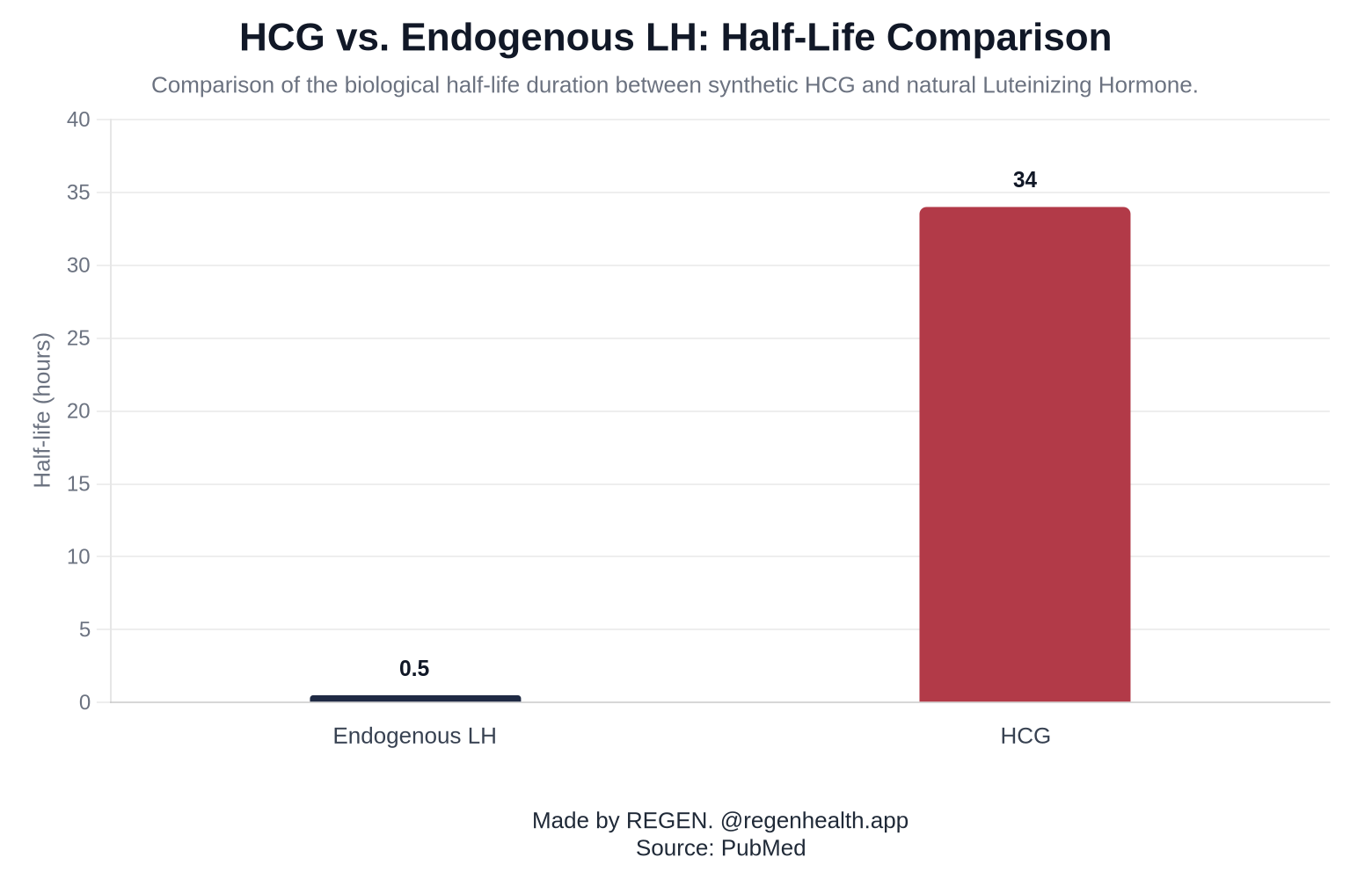
Analyzing the duration of a specific molecule's biological half-life, defined as the precise time required for half of the active compound to be metabolized and eliminated, allows practitioners to maintain stable blood concentrations. By continuously tracking these distinct metabolic markers, clinical researchers maintain a completely transparent picture of the ongoing pharmacokinetic profile. This objective, data-driven methodology completely eliminates the reliance on generic assumptions, providing a mathematical framework for long-term evaluations.
FAQ
How does hCG make men feel?
Subjective responses vary heavily based on individual endocrine panels and the clinical management of systemic estrogen ratios, rather than a direct, universal feeling derived from the compound itself. Medical literature prioritizes the tracking of quantitative biomarkers over subjective mood assessments when evaluating pharmacokinetic profiles.
Does hCG make you bigger?
No approved medical literature documents the use of this specific compound for directly increasing muscle mass or physical size. While frequently discussed in athletic contexts, clinical studies focus primarily on its structural properties, immunomodulatory derivatives, and female fertility applications.
Which is better, TRT or hCG?
These represent entirely distinct clinical interventions rather than interchangeable therapies. Testosterone replacement therapy directly provides exogenous testosterone, whereas the use of chorionic gonadotropins involves complex structural pathways and is heavily researched for completely different reproductive and immunomodulatory endpoints.
How quickly does hCG start working for men?
Pharmacokinetic properties dictate that systemic absorption begins rapidly, but the exact timeline for measurable biological changes depends entirely on the specific protocol and delivery method. Clinical trials measure exact serum concentrations over time to determine when a compound reaches peak systemic availability.