BPC-157 Peptides: Regulatory Status and Clinical Evidence
BPC-157 is an experimental 15-amino-acid synthetic pentadecapeptide that currently lacks published controlled human trials for injury or tendon recovery. It is not FDA-approved for human use; sold for research purposes only. The compound faces a critical regulatory transition, as the FDA has scheduled its removal from 503A category 2 status for April 22, 2026, ending its use in legal compounded preparations.
01 — Defining the synthetic pentadecapeptide
BPC-157 is a synthetic 15-amino-acid sequence with the chemical formula C62H98N16O22, studied exclusively in laboratory settings. It remains an experimental research chemical with no established safety profile or approved human indications, requiring rigorous objective biomarker monitoring if investigated.
The compound is frequently discussed in physiological recovery contexts, yet the foundation of this discourse relies entirely on preclinical data. Without human trials to validate its mechanisms, the peptide is restricted to off-label research applications. A comprehensive literature and patent review analyzed the multifunctionality and possible medical application of this peptide in various preclinical models. To monitor systemic safety when researching such compounds, baseline testing of inflammatory and hepatic markers is strictly required to detect potential off-target biological responses.
02 — The April 2026 regulatory shift
The FDA formally removed BPC-157 from 503A category 2 status on April 22, 2026, officially terminating its legal use in compounded pharmaceutical preparations. This action classifies the peptide as an unauthorized substance for standard compounding pharmacies.
This regulatory deadline addresses the significant clinical ambiguity surrounding the compound. For years, the peptide was prepared under exemptions that allowed compounding facilities to distribute it before full clinical validation was completed. The April 2026 shift effectively closes this pathway, underscoring that subjective recovery reports cannot substitute for formal, peer-reviewed clinical trials. Researchers and institutions focusing on these peptides must now navigate a landscape where clinical-grade pharmaceutical access is heavily restricted by federal oversight.
03 — The preclinical evidence gap
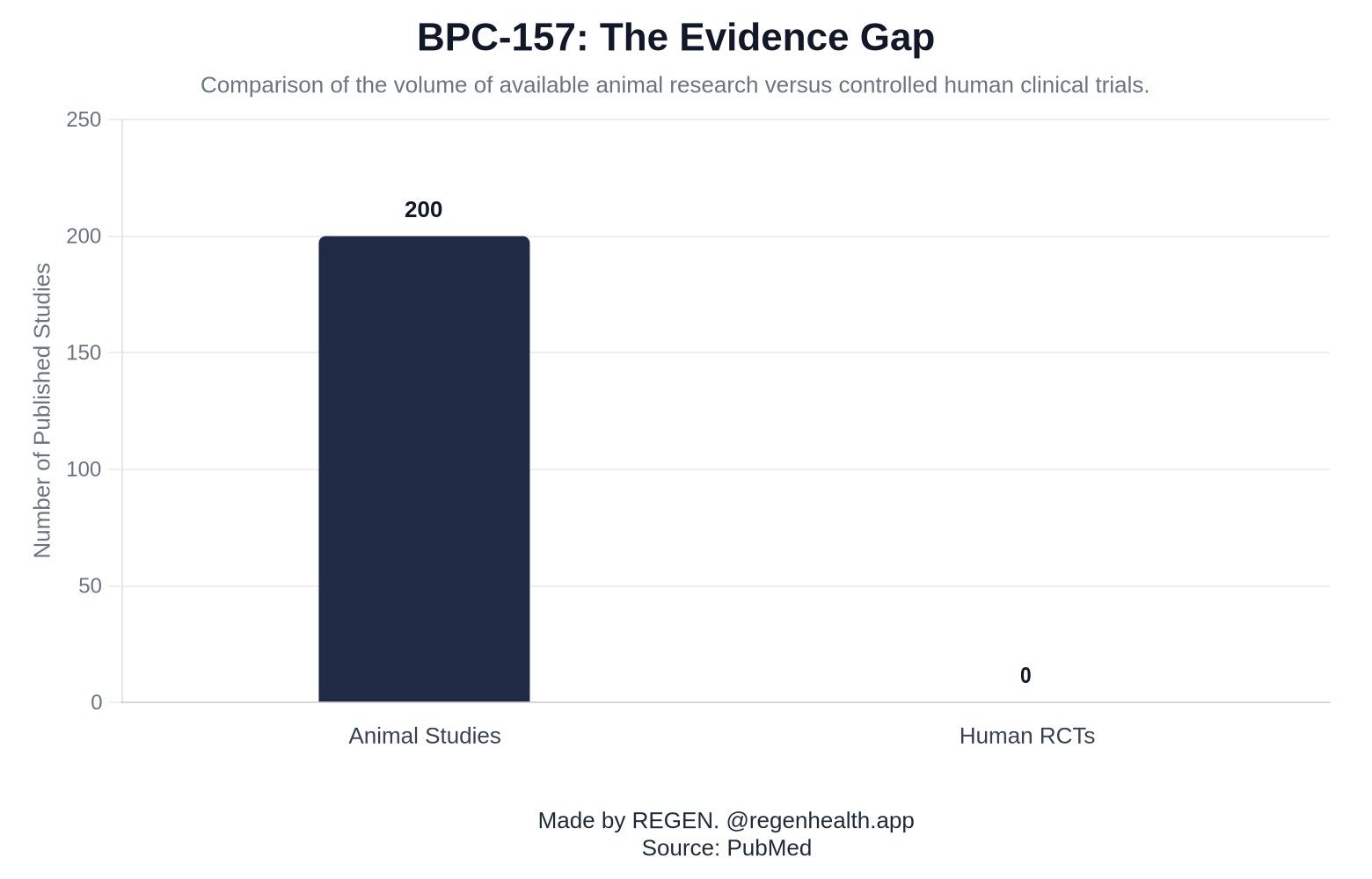
Extensive animal models have investigated the peptide, but there are zero published controlled human RCTs for tendon or injury recovery. This massive gap between in vivo animal models and actual human validation defines the current state of biological research.
While animal models demonstrate varied biological activity, these findings do not automatically translate to human physiology or metabolic pathways. Relying on objective biomarker tracking-such as monitoring hs-CRP for systemic inflammation-provides a factual framework for evaluating physiological states rather than depending on subjective physical recovery anecdotes. Research continues to investigate whether injectable therapeutic peptides might serve as an adjunct to regenerative medicine and sports performance, though formal validation remains entirely absent. Those investigating related compounds like TB-500 also face similar requirements for rigorous, objective biological tracking.
04 — Musculoskeletal healing in animal models
Preclinical rodent studies indicate that the peptide influences musculoskeletal tissue repair pathways, though these cellular effects have never been confirmed in human subjects. Current structural data is strictly limited to experimental laboratory settings.
A narrative review of BPC-157 for musculoskeletal healing assessed the available preclinical evidence, highlighting the clear dichotomy between the regeneration potential observed in animals and the risk of unverified human application. In laboratory environments, the compound appears to interact with cellular mechanisms related to tendon and muscle tissue integrity in rodents. However, the exact physiological pathways remain unclear, and the total absence of pharmacokinetic data in humans means that human dosing protocols and long-term tissue responses remain entirely speculative.
05 — Pain management in experimental settings
Animal models have explored the peptide's role in localized tissue repair and central analgesia, identifying potential interactions with peripheral pain pathways in rodents. No human pain management protocols or safety profiles exist.
In preclinical trials, investigators have documented changes in structural repair and nociceptive response in isolated tissue samples. A specific evaluation of the role of BPC-157 in tissue repair and pain management demonstrated these analgesic properties strictly within in vivo animal frameworks. Because these precise mechanisms have not been subjected to human clinical trials, researchers cannot predict whether similar nociceptive modulation occurs in human subjects or if the compound merely masks underlying inflammatory processes.
06 — Tracking objective systemic markers
Evaluating the biological impact of research compounds requires baseline and continuous monitoring of systemic health indicators like GGT, ALT, and AST. This clinical-intelligence approach replaces speculative assumptions with objective serum data.
Without standardized pharmaceutical oversight or established human safety profiles, experimental peptides carry unknown risks of off-target physiological effects. Hepatic stress and systemic inflammation are primary concerns when introducing unregulated synthetic amino acid sequences into biological systems. Measuring high-sensitivity C-reactive protein (hs-CRP) provides a quantifiable metric for systemic inflammation, allowing for the detection of adverse physiological shifts. Rather than asking unanswerable questions about unproven efficacy, the analytical focus must remain strictly on whether specific inflammatory and metabolic profiles show objective, measurable changes over time.
FAQ
What does BPC-157 do to your body?
The exact physiological effects in humans are currently unknown due to a complete lack of published randomized controlled trials. In animal models, the synthetic peptide has been observed to interact with tissue repair and inflammatory pathways, but these preclinical findings do not establish human efficacy or safety. The compound is not FDA-approved for human use and is sold for research purposes only.
What are the negative effects of BPC-157?
The long-term negative effects in humans remain undefined because the compound has never undergone formal clinical safety testing. Without standardized pharmaceutical trials, potential risks include off-target biological responses, hepatic stress, and unpredictable systemic inflammation, making objective biomarker monitoring essential during any experimental research.
Is it safe to take BPC-157 daily?
No safety profile or approved daily dosage has ever been established for this compound in human subjects. It remains an experimental research chemical with zero clinical trial validation, and the FDA has mandated its removal from 503A compounding status, emphasizing its unverified safety status and the lack of standardization.