Cagrilintide: Amylin Receptor Agonism and Clinical Data
Cagrilintide is an investigational dual amylin and calcitonin receptor agonist being researched for metabolic and body mass management. It operates through distinct physiological pathways, targeting satiety signals in the hindbrain rather than relying solely on the incretin system. Currently, the compound is not FDA-approved for human use and remains restricted to controlled clinical trials and research environments.
01 — What is cagrilintide exactly
Cagrilintide functions as a long-acting synthetic analogue of amylin, a hormone normally co-secreted with insulin by pancreatic beta cells in response to food intake. By agonizing both amylin and calcitonin receptors in the brain, this peptide influences gastric emptying and central satiety signaling. Cagrilintide is not FDA-approved for human use; it is sold for research purposes only.
Early experimental models indicate that modulating these specific neurological receptors independently offers a distinct mechanism for metabolic control. In preclinical environments, researchers often utilize cagrilintide 10mg lyophilized vials to prepare precise dilutions for cellular and animal studies. While other clinical peptide formulations target early incretin signaling pathways, such as the Orforglipron: Oral GLP-1 Small Molecule Dynamics, cagrilintide focuses entirely on post-prandial satiety signals mediated predominantly by the hindbrain.
02 — Clinical trial weight loss data
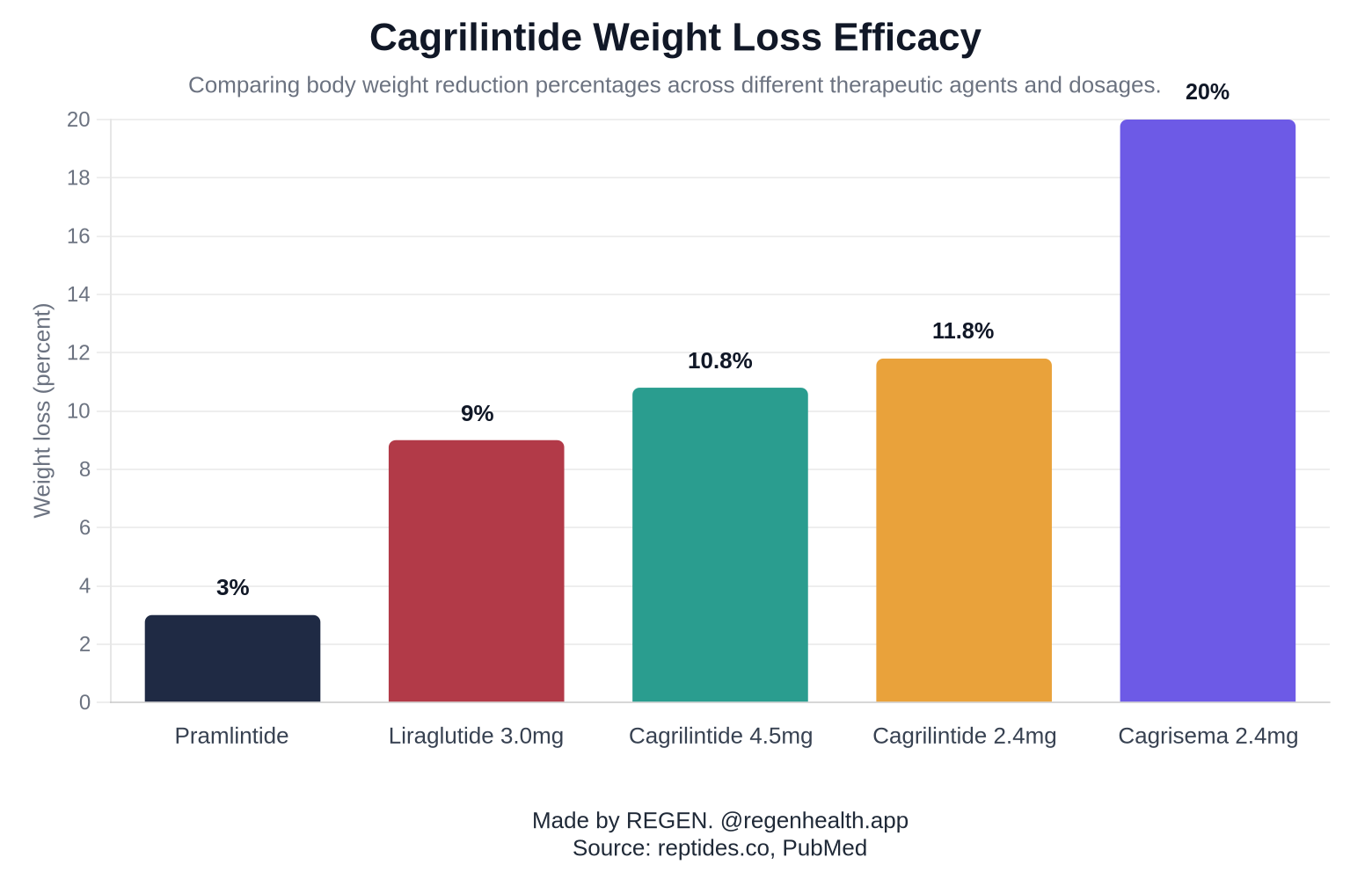
In published literature, cagrilintide demonstrates specific dose-dependent effects on body mass in clinical populations presenting with overweight and obesity. During initial evaluations of its standalone efficacy, Cagrilintide has achieved weight loss exceeding 10% of total body weight in early clinical trials.
By comparison, earlier generations of amylin therapeutics showed narrower efficacy parameters when tested in similar patient cohorts. Specifically, Pramlintide, an amylin analog, demonstrated weight loss exceeding 3% in study periods. These measured metrics establish the standalone baseline of amylin agonism when administered as a primary therapeutic agent in controlled clinical settings, highlighting the evolution of half-life extension technologies in modern peptide engineering.
03 — The combination with semaglutide
Researchers are testing the concurrent administration of amylin agonists with GLP-1 receptor agonists to evaluate potential synergistic effects on metabolic markers and body mass. In specific clinical models, the combination of cagrilintide 2.4mg plus semaglutide 2.4mg (Cagrisema) is expected to achieve weight loss in the range of 15-25%.
Researchers evaluated these dual-pathway synergistic effects directly by studying co-administered once-weekly cagrilintide 2·4 mg with once-weekly semaglutide 2·4 mg in type 2 diabetes during a comprehensive phase 2 trial. These concurrent administration models aim to determine whether targeting the area postrema alongside the hypothalamus produces additive reductions in total energy intake.
04 — Amylin versus GLP-1 pathways
The physiological differences between pure amylin agonists and incretin mimetics center on their respective neurological targets and binding affinities in the central nervous system. While GLP-1 therapeutics primarily target receptors located in the hypothalamus to regulate appetite, cagrilintide acts specifically on calcitonin and amylin receptors located in the area postrema of the hindbrain.
This independent pathway activation explains why combining the two compounds produces additive reductions in food intake in early animal models. Similar to how specific peptide complexes operate within distinct cellular environments, such as those discussed in The peptides inside the KLOW blend, individually studied, isolating separate receptor targets often yields entirely distinct physiological markers during rigorous clinical assessment.
05 — Phase 2 dose-finding trial outcomes
The specific titration schedules and dosing thresholds for cagrilintide were established through structured clinical evaluation involving multiple active cohorts and placebo controls. Researchers mapped these baseline metabolic responses by publishing data on once-weekly cagrilintide for weight management in people with overweight and obesity.
This multicentre, randomised, double-blind, placebo-controlled and active-controlled, dose-finding phase 2 trial demonstrated that escalating doses of the investigational peptide led to measurable, sustained reductions in energy intake in the trial population. The trial structure allowed researchers to separate the compound's standalone pharmacodynamics from the overlapping clinical effects normally observed during simultaneous GLP-1 administration.
06 — Regulatory status and safety profile
Evaluating the tolerability of new investigational peptide therapeutics requires analyzing trial dropout rates and the incidence of gastrointestinal adverse events. As an experimental compound, cagrilintide is strictly sold for research purposes only and lacks FDA approval for human use in any clinical context.
The most frequently documented adverse events in trial populations involve mild to moderate gastrointestinal distress, particularly nausea and delayed gastric emptying, which typically coincide with aggressive dose escalation phases. This specific side effect profile mirrors other appetite-modulating compounds, necessitating gradual and heavily monitored titration schedules in controlled clinical environments to maintain patient adherence during research protocols.
FAQ
Is cagrilintide better than semaglutide?
Clinical evidence indicates that combining the two compounds produces additive effects, rather than one being strictly superior as a standalone treatment. Trials show that dual administration targets different neurological pathways to compound total energy intake reduction.
How does cagrilintide make you feel?
In clinical trials, participants frequently reported feelings of early satiety and reduced appetite during meals. Adverse event logs also indicate that subjects commonly experienced mild to moderate nausea during initial dose titration phases.
How many days a week do you take cagrilintide?
In published phase 2 and phase 3 clinical trials, researchers administered the compound on a once-weekly dosing schedule. The peptide is engineered with an extended half-life to accommodate this spacing in clinical models.
Is cagrilintide good for weight loss?
Trial data shows that cagrilintide functions as an effective agent for body mass reduction in specific populations. Early clinical trials reported total body weight reductions exceeding 10% when administered as a standalone therapy over the study period.