Semax Nasal Spray: Delivery and Cold Chain Integrity
Semax requires specialized administration routes to remain biologically viable, as gastrointestinal enzymes rapidly destroy the synthetic peptide structure. Intranasal delivery utilizes the olfactory and trigeminal nerve pathways to bypass first-pass hepatic metabolism entirely. Maintaining strict cold-chain integrity during reconstitution and storage is the fundamental requirement to prevent degradation and preserve the compound's neuroprotective efficacy.
01 — Avoiding hepatic metabolism
The primary obstacle in synthetic peptide administration is the highly acidic environment of the human digestive tract. Oral administration is ineffective due to rapid degradation by gastrointestinal enzymes. When a peptide enters the stomach and small intestine, proteases cleave the delicate amino acid bonds long before the intact molecule can enter systemic circulation.
Even if a fraction of the peptide survived digestive enzymes, it would immediately travel through the portal vein to the liver, where first-pass metabolism breaks it down into constituent amino acids. To exert any central nervous system effects, Semax must circumvent these two biological barriers completely.
02 — Olfactory nerve transport
The application of a liquid solution to the nasal mucosa provides a direct anatomical conduit to the brain. Intranasal delivery bypasses first-pass hepatic metabolism via olfactory and trigeminal pathways. These nerve networks extend through the cribriform plate at the roof of the nasal cavity, creating a porous boundary between the external environment and the central nervous system.
Discussions evaluating Selank vs Semax frequently center on this shared absorption mechanism. Both heptapeptides rely on the highly vascularized nasal epithelium to cross the blood-brain barrier intact, preserving their molecular structure for cellular receptor interaction.
03 — Acute stroke dosing models
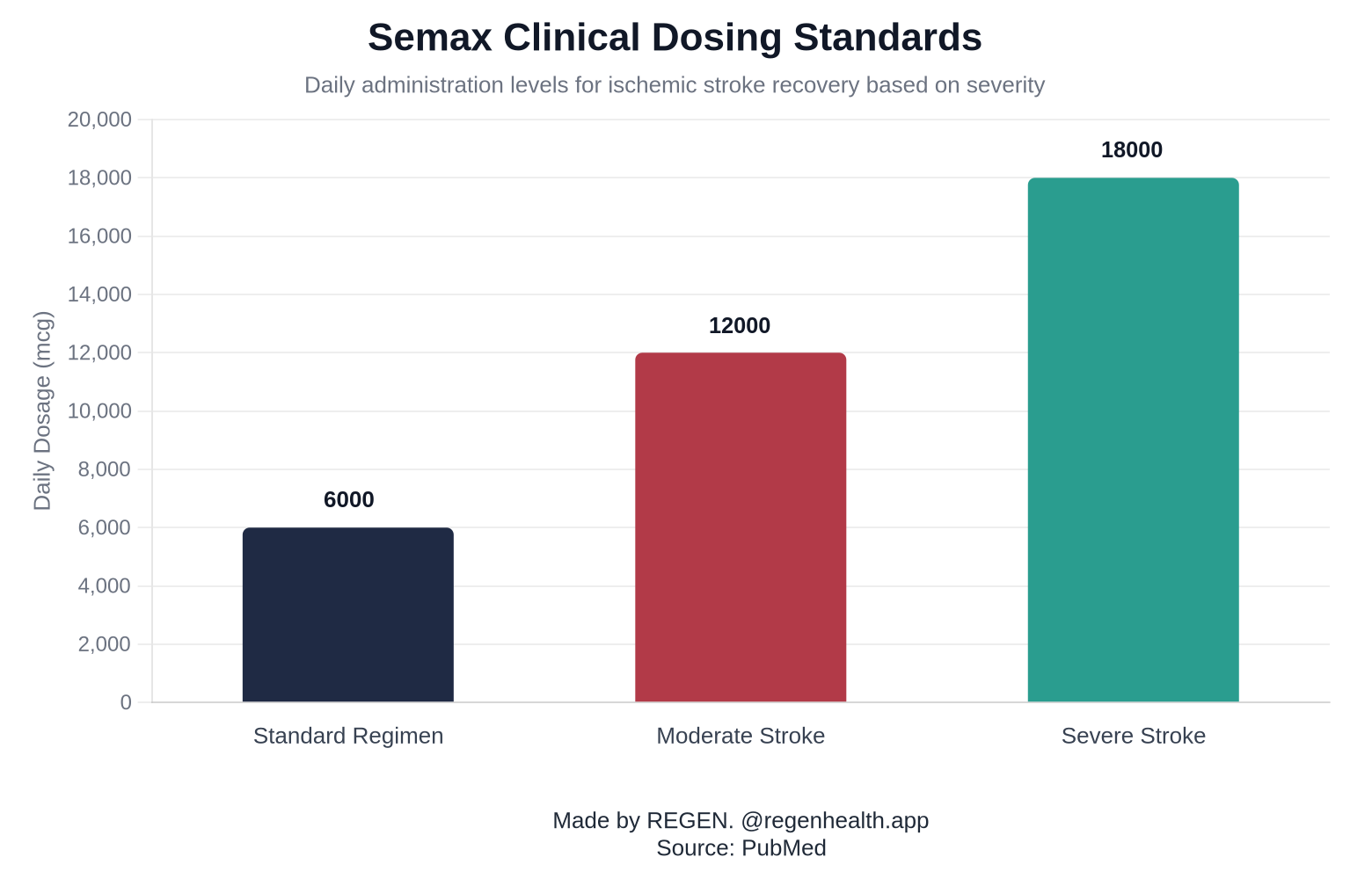
Clinical protocols establish clear baseline concentrations for the peptide's application in acute neuroprotective settings. Administration of Semax in acute ischemic stroke patients increased the rate of restoration of neurological functions, with effective daily doses of 12 mg for moderate strokes and 18 mg for severe strokes.
These clinical parameters highlight the volume of the compound required to initiate measurable physiological recovery following severe ischemic events. The required milligrams far exceed the quantities often utilized in generalized cognitive research contexts.
04 — Clinical interval regimens
Researchers structure neuroprotective treatments around specific administration cycles to maintain therapeutic serum levels without causing receptor desensitization. The Standard regimen of Semax for ischemic stroke patients involved 2 courses of 6000 mcg/day for 10 days with a 20-day interval.
This structured dosing mapped to clinical recovery metrics ensures the active peptide remains available during the critical phases of post-stroke neuronal repair. Translating these protocols into localized research requires adherence to the timing and suspension intervals documented in the primary literature.
05 — Cold chain stability
The molecular integrity of reconstituted peptide bonds is highly sensitive to ambient temperature and agitation. Reconstituted solutions must be stored at 2-8°C and remain stable for up to 28 days. Once a freeze-dried powder is mixed with bacteriostatic water, the resulting solution immediately becomes vulnerable to thermal degradation.
Failing to maintain this narrow cold-chain environment yields a clinically inert liquid. Subjects utilizing compounds like BPC-157 or other synthesized peptide chains must implement identical thermal monitoring, as silent degradation eliminates the compound's pharmacological viability long before visual changes appear in the vial.
06 — Neuroprotective biomarkers
Investigators track subjective cognitive states and inflammatory markers to determine the physiological impact of peptide regimens. Research into the neuroprotective effects of peptides bioregulators in people of various age demonstrates measurable shifts in recovery profiles when the compound is administered under clinical supervision.
Further documentation of neuro-restorative applications includes the study of chronic partial denervation and quality of life in patients with motor neuron disease treated with semax. These targeted investigations highlight the peptide's ability to modulate cellular repair mechanisms under specific, severe pathological conditions.
07 — Regulatory status
Semax is not FDA-approved for human use in the United States and is legally classified and sold for research purposes only. While it is an approved pharmaceutical intervention in Russia for stroke and related acute neurological disorders, its use elsewhere remains strictly experimental.
Without regulatory oversight in the United States, commercial availability occurs through gray-market suppliers. This reality presents profound challenges for ensuring the precise cold-chain transport required to maintain the stability of the peptide before reconstitution.
FAQ
What are the benefits of Semax nasal spray?
Semax is documented in Russian clinical settings to accelerate the restoration of neurological functions following severe acute ischemic strokes. It exerts measurable neuroprotective effects on damaged neuronal pathways when administered intranasally to bypass hepatic destruction.
Is Semax nasal spray illegal?
Semax is not a controlled substance, but it is not FDA-approved for human consumption in the United States. It operates in a regulatory gray area where it is legally manufactured and distributed explicitly for research purposes only, though it remains an approved prescription medication in Russia.
Can Semax be taken as a nasal spray?
Intranasal spray is the primary route of administration because the compound requires delivery via the olfactory and trigeminal nerve pathways. This specific mechanism allows the peptide molecules to pass directly into the central nervous system without facing destruction from gastrointestinal enzymes.
Does Semax act like a stimulant?
While studied for its effects on cognitive recovery and neurological function, Semax is a synthetic peptide that modulates brain-derived neurotrophic factor (BDNF) rather than functioning as a traditional amphetamine-class stimulant. It lacks the central nervous system catecholamine release mechanisms typical of conventional stimulants.