Orforglipron Para Que Sirve: Clinical GLP-1 Efficacy Data
Orforglipron is an investigational compound evaluated as an oral non-peptide drug targeting metabolic pathways. Understanding orforglipron para que sirve requires examining its function as a glucagon-like peptide-1 receptor agonist. Not FDA-approved for human use; sold for research purposes only. Clinical literature evaluates its potential to alter metabolic markers.
01 — Oral delivery of small molecules
Orforglipron is currently being investigated as an oral small-molecule GLP-1 receptor agonist for obesity treatment. Unlike traditional peptide hormones that require subcutaneous injection to avoid enzymatic degradation in the gastrointestinal tract, small molecules are structurally distinct synthetic compounds designed specifically for oral bioavailability. Research focuses on evaluating how this specific delivery method affects systemic metabolic pathways in test subjects over extended observation periods. Not FDA-approved for human use; sold for research purposes only.
Transitioning from injectable peptides to oral small molecules requires rigorous clinical assessment to confirm whether receptor activation remains consistent across different biological delivery vectors. Clinical development attempts to replicate the systemic tissue engagement seen in larger peptide structures while utilizing a compound compact enough to cross physiological barriers without immediate enzymatic destruction in the stomach.
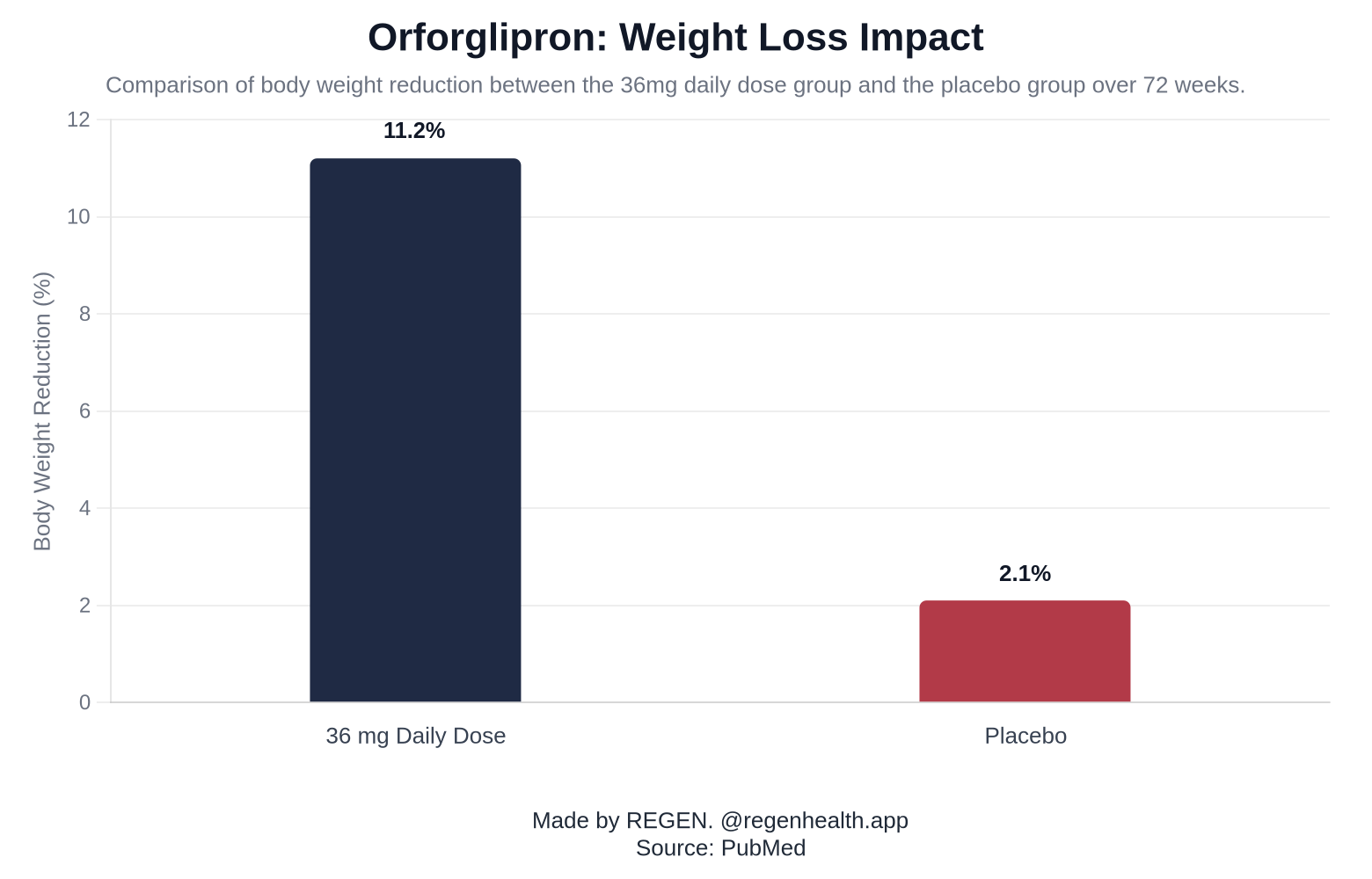
02 — Mechanisms in obesity treatment
GLP-1 receptor agonists function by engaging biological pathways that directly influence energy balance and metabolic regulation. Current research evaluates the specific mechanisms involved in obesity treatment, focusing on how systemic receptor activation alters physiological homeostasis across multiple organ systems. The physiological response to these compounds involves broad tissue engagement rather than isolated, simplistic caloric restriction.
In clinical research settings, the application of GLP-1-based medications necessitates rigorous tracking of the underlying physiological trade-offs. Successful metabolic recalibration depends on observing these internal shifts, establishing a heavily data-driven approach to tracking changes in body composition alongside baseline metabolic markers. Evaluating the compound's effect on target receptors helps researchers map the complex progression from initial cellular engagement to broader systemic changes in mass and continuous energy utilization.
03 — Efficacy in non-diabetic adults
Recent systematic reviews of randomized controlled trials specifically analyze the efficacy and safety of glucagon-like peptide-1 receptor agonists for weight loss among adults without diabetes. This distinction in the research literature is critical because human populations without preexisting glycemic dysfunction often respond differently to powerful insulinotropic agents. Researchers meticulously measure changes in total body mass alongside stringent safety profiles to determine if the therapeutic window observed in diabetic populations accurately translates to cohorts strictly seeking weight reduction.
Continuous monitoring of these non-diabetic cohorts helps clinical investigators isolate the exact weight-loss effects from the separate glycemic control effects. By isolating adult cohorts lacking a formal diabetes diagnosis, researchers can accurately assess how baseline metabolic flexibility influences the overall magnitude of body mass reduction and the specific frequency of reported adverse events during the predefined clinical trial timeline.
04 — Evaluating clinical trial data
The clinical research landscape continues to aggressively document the emerging role of GLP-1 agonists in obesity through comprehensive randomized controlled trials. These structured trials establish necessary baseline expectations for physiological responses over varied and extended treatment durations. By structuring long-term observational studies, clinical researchers attempt to precisely map the trajectory of tissue adaptation and long-term metabolic stabilization.
Understanding these longitudinal patterns is essential when comparing different novel agents within the same class, such as contrasting oral small molecules with the established Tirzepatide Titration and Efficacy Dynamics observed in injectable dual agonists. Comprehensive literature reviews aggregate data across thousands of participating subjects to identify consistent outcome patterns, ensuring that isolated clinical trial anomalies do not skew the scientific understanding of how long-term GLP-1 receptor activation fundamentally alters body composition metrics.
05 — Tracking physiological markers
Evaluating the clinical outcomes of GLP-1 receptor agonists demands granular, continuous attention to specific physiological markers throughout the entire administration period. Trials assessing these investigational compounds consistently emphasize that raw mass reduction alone is an incomplete and often misleading metric for assessing metabolic health. Researchers monitor fasting glucose levels, systemic insulin sensitivity, and the critical retention of lean muscle mass to ensure the pharmacological intervention promotes true metabolic stability rather than mere un-targeted muscle wasting.
The clinical focus remains heavily on differentiating passive weight loss from active, sustained metabolic recalibration, utilizing structured clinical endpoints to quantify tissue-level changes throughout the required dosing cycle. Relying solely on basic scale metrics actively obscures critical data regarding tissue composition and deep metabolic shifts, making strict biomarker tracking a fundamental requirement for accurately assessing the true biological efficacy of any receptor agonist protocol.
06 — Assessing risks and trade-offs
The ongoing clinical evaluation of oral small molecules requires a highly clear and objective assessment of GLP-1 benefits and risks across completely different demographics and metabolic baselines. Every single pharmacological intervention introduces complex physiological trade-offs, and small-molecule oral agonists are absolutely no exception to this medical reality. Accurately determining the risk profile involves strict monitoring of gastrointestinal adaptation, systemic tolerability, and specific compound clearance rates during the active administration phase.
Current clinical literature consistently emphasizes that understanding these biological dynamics allows researchers to safely establish necessary safety parameters and effectively refine the future application of these compounds in broader metabolic health studies. Continuous and rigorous observation during extended trial periods ensures that potential adverse events are documented meticulously and weighed carefully against the quantitative reductions in overall body mass, providing a transparent and balanced clinical profile.
FAQ
¿Para qué se utiliza el orlistat?
Orlistat is utilized clinically to prevent the gastrointestinal absorption of dietary fats. By inhibiting gastric and pancreatic lipases, it alters lipid metabolism during the digestive process rather than acting systemically on GLP-1 receptors.
¿La metformina ayuda a bajar de peso?
Metformin is studied for its effects on metabolic markers, which can result in minor weight reduction in specific populations. However, it is primarily evaluated for glycemic control and insulin sensitivity rather than functioning as a dedicated weight-loss medication.
¿Qué precio tiene el orforglipron?
Orforglipron is an investigational research compound, meaning it does not currently have a commercial prescription price. It remains in clinical trials and is explicitly not FDA-approved for human use.
¿Cuántos kilos puedes bajar con orlistat?
Clinical literature indicates that weight reduction with orlistat varies heavily based on trial duration and baseline metabolic status. Studies generally measure a percentage of total body mass reduction rather than a guaranteed or fixed number of kilograms.
What are the side effects of GLP-1 drugs?
The side effects of GLP-1 drugs frequently include gastrointestinal adaptation issues, such as nausea and changes in gastric emptying. Clinical trials monitor these tolerability metrics continuously to establish comprehensive safety profiles across different delivery methods.