Is Retatrutide the Same as Ozempic? Clinical Trial Outcomes
Retatrutide and Ozempic operate through fundamentally different mechanisms with distinct safety profiles. While Ozempic is an FDA-approved single-receptor agonist for type 2 diabetes, retatrutide is an investigational triple-agonist that demonstrates significant weight and liver fat reductions in clinical trials, alongside notable neurological side effects at higher doses.
Defining the mechanistic difference
The primary difference between Ozempic and retatrutide lies in their receptor profiles. Ozempic is a single-pathway agent, whereas retatrutide incorporates three distinct hormonal pathways. Retatrutide is not FDA-approved for human use and remains strictly investigational, sold for research purposes only.
A systematic review of randomized controlled trials analyzed the efficacy and safety of GLP-1 receptor agonists for weight loss among adults without diabetes. Single-target agents like semaglutide, the active ingredient in Ozempic, establish a specific metabolic ceiling. The clinical literature detailing GLP-1 receptor agonists demonstrates that in adult patients, these single-pathway medications produce their effects primarily by delaying gastric emptying and acting on appetite centers in the brain.
By contrast, multi-receptor compounds represent a different pharmacological category. Published research detailing the mechanisms of action and therapeutic applications of GLP-1 and dual GIP/GLP-1 receptor agonists shows how in clinical trials, adding additional receptor targets alters metabolic responses compared to single agonists. Retatrutide expands this further as an investigational molecule combining three separate structural mechanisms.
Clinical weight loss outcomes
Clinical data indicates that the triple-agonist formulation of retatrutide alters body weight over extended periods. In trial populations, these multi-receptor interactions result in a higher magnitude of weight reduction than typically observed in single-agonist studies, reflecting a distinct metabolic response requiring careful observation.
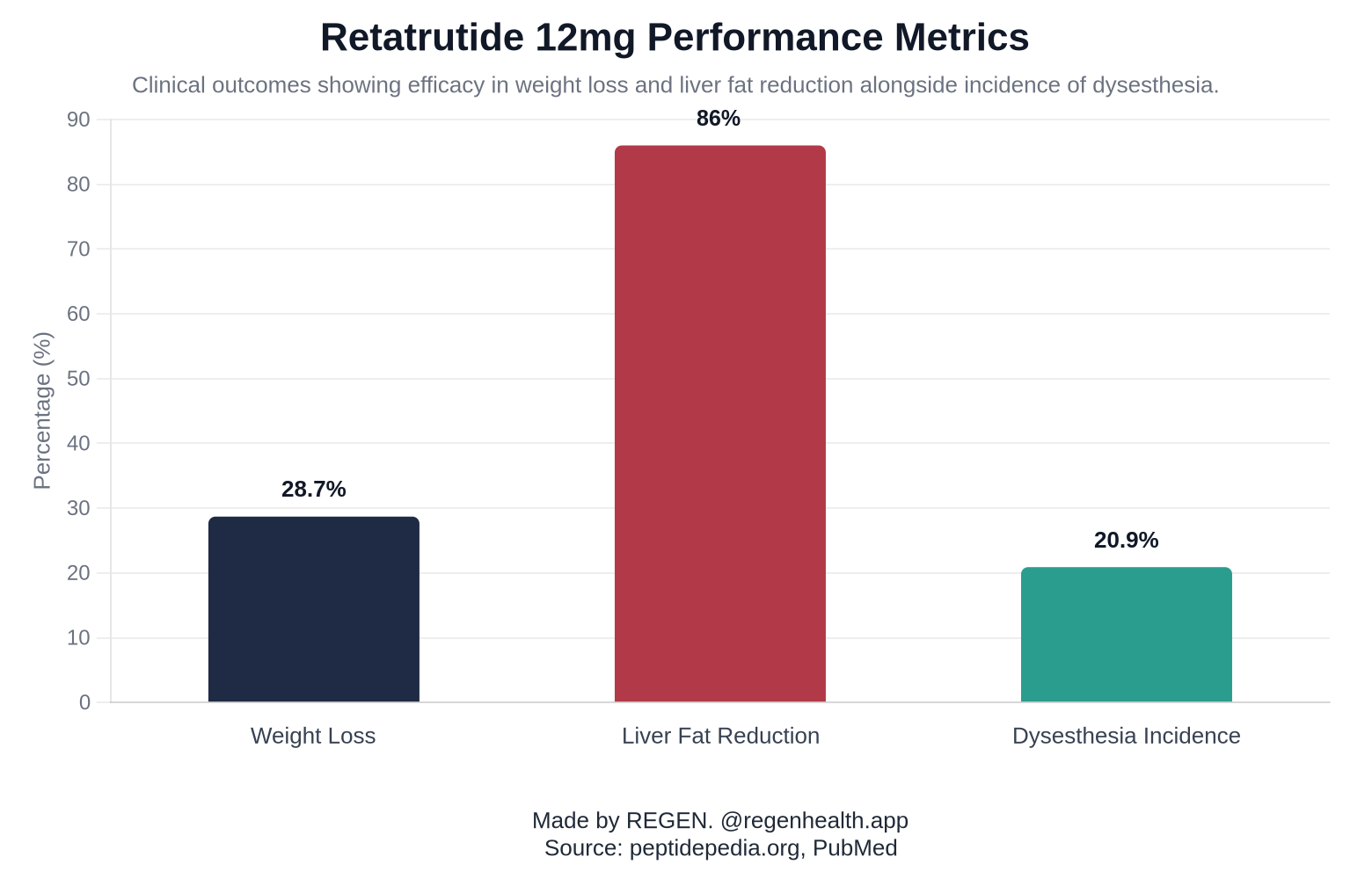
A comprehensive review of randomized controlled trials notes the emerging role of GLP-1 agonists in obesity, setting a baseline for expected outcomes with single-target therapies. Retatrutide establishes a different trajectory in specific trial populations. Specifically, Retatrutide demonstrated 28.7% mean weight loss at 68 weeks in the TRIUMPH-4 trial. This magnitude of reduction underscores how activating three pathways simultaneously shifts the overall metabolic ceiling in controlled clinical settings.
The measurement of these physiological changes relies on continuous tracking during the clinical study. Researchers document body mass alterations at regular intervals to map the precise curve of the metabolic response. Observing these metrics ensures that the investigational data captures the complete profile of the compound across the entire duration of the trial.
Hepatic fat reduction in trials
Beyond body weight, retatrutide exhibits a pronounced effect on liver fat accumulation in specific patient populations. The glucagon-mediated activity in its triple-agonist profile drives hepatic metabolic changes in trial subjects, leading to measurable decreases in liver fat content at higher titration levels.
While early single-receptor therapies established a baseline for metabolic management, the inclusion of the glucagon mechanism in retatrutide alters hepatic outcomes in clinical trials. Data from specific populations highlights this capacity. Phase 2 MASLD cohorts showed an 82-86% relative reduction in liver fat at the 12 mg dose. This profound reduction in the liver fat compartment illustrates the distinct tissue-specific effects of the triple-agonist formulation compared to standard GLP-1 agents.
Hepatic fat measurements serve as a primary indicator of metabolic flux in these specialized trial groups. By analyzing the liver fat content before and after administration, clinical investigators quantify the exact degree of lipid clearance. These outcomes reinforce the necessity of monitoring localized organ changes rather than relying solely on total body mass measurements.
The dose-dependent symptom threshold
The metabolic outcomes of retatrutide are accompanied by specific neurological side effects in clinical trial subjects that escalate with higher doses. Unlike the gastrointestinal side effects commonly associated with single GLP-1 agonists, retatrutide introduces sensory trade-offs that become highly prevalent as the dosage increases.
Managing the administration of multi-receptor compounds requires close observation of adverse events. During clinical evaluation, Dysesthesia (tingling/numbness) incidence increased with dose, reaching 20.9% at 12 mg compared to 0.7% for placebo. This high rate of sensory disturbances at the maximum evaluated dose highlights a critical symptom threshold that appears distinct from earlier incretin therapies.
Patients and clinicians in trial settings weigh the significant metabolic changes against these neurological side effects. The onset of sensory issues directly correlates with the highest titration brackets, marking a clear physiological limit. Documenting these incidence rates is necessary to fully establish the safety parameters of the compound under rigorous clinical observation.
Comparing single to triple agonists
Evaluating whether to transition between these classes involves comparing the established safety profile of a single agonist against the investigational potency of a triple agonist. The difference between Ozempic and retatrutide is not simply a matter of strength, but a shift in the overall side effect profile.
Because retatrutide remains an investigational compound without FDA approval, switching from semaglutide to retatrutide involves moving from an established medical treatment to an experimental paradigm. Researchers continue to evaluate experimental compounds like cagrilintide retatrutide combinations to understand how merging different mechanisms alters both efficacy and safety in human subjects. Clinical trials indicate that while triple agonists push metabolic boundaries further, they introduce complex sensory side effects that single-target GLP-1 medications typically avoid.
Any transition between these classes fundamentally shifts the baseline maintenance protocol. Single-target agents operate within well-documented clinical guidelines, whereas triple agonists demand strict oversight in trials to monitor escalating side effects. The clinical literature underscores that the investigational status of retatrutide requires specialized management protocols that differ completely from standard prescription adjustments.
The reality of continuous titration
Clinical management of multi-receptor agonists requires structured titration to monitor both metabolic changes and the onset of sensory symptoms. As researchers evaluate these compounds, step-up dosing protocols in clinical trials reveal exactly when side effects begin to outweigh the measured physiological changes.
Rather than a straightforward escalation, the data shows that adverse events trace the dose curve closely. The high incidence rate of sensory issues at the maximum evaluated dosages establishes a boundary for tolerable administration in trial subjects. Monitoring these outcomes ensures that the evaluation of investigational agents accounts for both the total physiological impact and the specific neurological thresholds crossed during titration.
Continuous tracking of both biomarkers and physical symptoms remains the standard in these trials. Investigators map the severity of dysesthesia alongside the rate of weight and liver fat reduction to determine the precise point of diminishing returns. This clinical data provides the foundation for understanding the strict limitations placed on triple-agonist research models.
Frequently asked questions
Is reta stronger than Ozempic?
Clinical trials show that retatrutide produces a higher magnitude of weight and liver fat reduction than semaglutide in specific populations. However, retatrutide is an investigational triple-agonist sold for research purposes only, while Ozempic is an FDA-approved single-agonist medication for type 2 diabetes.
What are the risks of taking retatrutide?
Retatrutide is not FDA approved for human use and carries significant side effects observed in clinical trials, including severe gastrointestinal issues and a notable incidence of dysesthesia. Sensory side effects like tingling and numbness increased substantially at the higher 12 mg trial doses.
Who cannot take retatrutide?
Because retatrutide is an investigational compound without FDA approval, it is not prescribed to the general public. In clinical trials, subjects with specific preexisting conditions or those unable to tolerate the severe sensory and gastrointestinal side effects are strictly excluded from participation.
Can I go from Ozempic to retatrutide?
Switching from semaglutide to retatrutide is not a standard clinical practice because retatrutide lacks FDA approval. Transitioning between an approved medical treatment and an investigational compound occurs only within tightly controlled, formally approved clinical research protocols.