What Not To Do On Tirzepatide: Managing Titration Dynamics
Clinical data indicates that mismanaging tirzepatide often stems from ignoring pharmacokinetic adaptation rather than simple dietary errors. Successful treatment requires aligning the titration schedule with objective metabolic markers like fasting glucose and HbA1c. Relying on subjective hunger cues without monitoring glycemic shifts frequently leads to suboptimal physiological responses.
01 — Managing the pharmacokinetic environment
A primary clinical error during tirzepatide administration is viewing the compound exclusively as an appetite suppressant while ignoring its broader metabolic mechanisms. The therapeutic focus must remain on the pharmacokinetic environment and how the body adapts to dual glucose-dependent insulinotropic polypeptide and glucagon-like peptide-1 receptor activation. Treatment protocols require consistent monitoring of fasting glucose, HbA1c, and lipid profiles to evaluate physiological adaptation.
When titration intervals proceed without verifying these objective metabolic markers, the incidence of gastrointestinal distress often increases. Clinical management demands that dosage adjustments correspond directly to documented changes in insulin sensitivity and gastric motility, rather than adhering to rigid, calendar-based schedules that ignore individual metabolic variances.
02 — Gastric emptying and hypothalamic signaling
The fundamental mechanism of dual agonists extends well beyond simple caloric restriction. Research demonstrates that GLP-1 receptor agonists and GIP/GLP-1 agonists reduce gastric emptying, inhibit glucagon secretion, and enhance satiety via direct effects on hypothalamic nuclei. This systemic alteration of gastrointestinal motility requires careful management during the initial weeks of therapy.
Failing to account for delayed gastric emptying frequently causes adverse events when dietary volume remains static. Because the compound actively modulates hypothalamic signaling centers, the normal physiological cues for fullness occur at significantly lower volumes of intake. Recognizing this mechanical and neurological shift is critical for maintaining therapeutic adherence and minimizing nausea.
03 — Measuring the glycemic impact
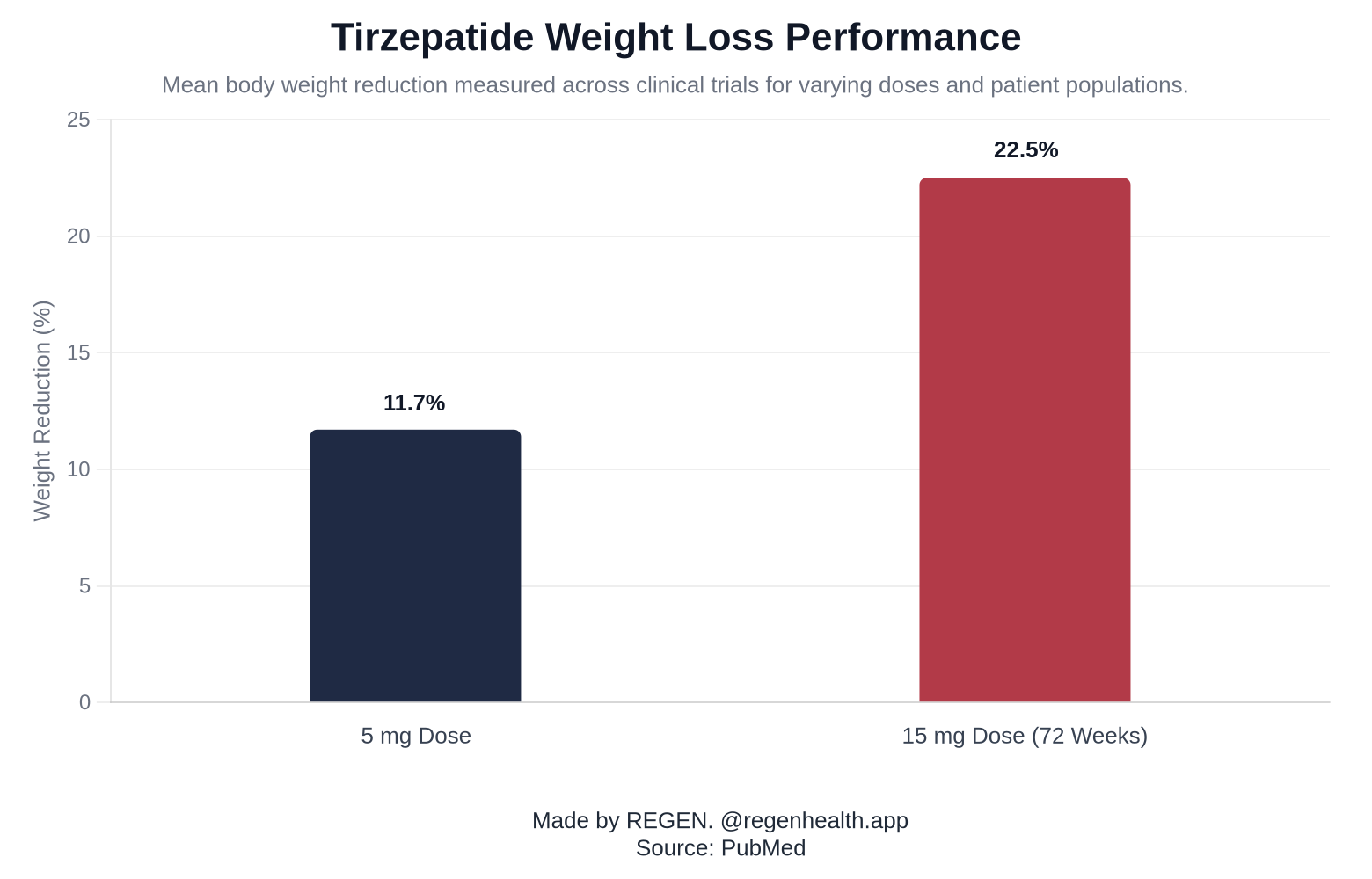
Objective measurement of glycemic control provides the clearest indicator of whether a specific dosage is achieving its therapeutic target. In clinical evaluations, tirzepatide at 5-15 mg per week reduced HbA1c by 1.24 to 2.58% and body weight by 5.4-11.7 kg in type 2 diabetic subjects. These precise reductions in glycated hemoglobin serve as a clinical benchmark for evaluating efficacy.
If an individual fails to demonstrate reductions within this specific HbA1c window, the primary issue is rarely an occasional dietary deviation. Instead, insufficient glycemic response suggests that the dose-to-satiety ratio or the titration interval requires recalibration based on the subject's unique insulin sensitivity profile.
04 — Understanding the efficacy variance
A widespread misconception regarding dual agonists is the expectation of uniform physiological responses across all patient populations. Clinical trial data reveals significant variance, showing that 20.7 to 68.4% of patients treated with tirzepatide lost more than 10% of their baseline body weight. This wide statistical spread highlights the necessity of individualized assessment.
Falling into the lower percentile of efficacy is not necessarily a result of incorrect dietary choices. The variance in baseline metabolic health, starting insulin resistance, and cellular receptor density all dictate how rapidly a patient adapts to the compound. Treatment plans must account for this clinical heterogeneity by tracking individual biomarkers over time.
05 — Evaluating cardiovascular risk factors
Metabolic health interventions require evaluating broader systemic outcomes, particularly concerning cardiovascular safety. The Tirzepatide versus insulin glargine in type 2 diabetes and increased cardiovascular risk (SURPASS-4): a randomised, open-label, parallel-group, multicentre, phase 3 trial provided essential data on how the compound performs in subjects with elevated risk profiles.
Monitoring cardiovascular markers alongside glycemic changes ensures a comprehensive view of therapeutic safety. The SURPASS-4 trial established parameters for evaluating heart rate variations and blood pressure shifts during the titration phase, demonstrating that dual agonist therapy alters multiple axes of metabolic and cardiovascular function simultaneously.
06 — Efficacy in non diabetic populations
While tirzepatide initially received clinical attention for managing type 2 diabetes, extensive evaluation has expanded into populations without established diabetic pathology. The Efficacy and Safety of Glucagon-Like Peptide-1 Receptor Agonists for Weight Loss Among Adults Without Diabetes : A Systematic Review of Randomized Controlled Trials analyzed the therapeutic outcomes and safety profiles in broader demographics.
This systematic review confirmed that the physiological mechanisms governing delayed gastric emptying and central satiety signaling apply to non-diabetic subjects. The clinical data emphasizes that even without a baseline of severe insulin resistance, strict adherence to evidence-based titration protocols remains mandatory to mitigate gastrointestinal adverse events.
FAQ
What should be avoided for weight loss?
Avoiding rigid titration schedules that ignore individual metabolic markers is critical. Clinical data indicates that ignoring objective markers like HbA1c reductions and relying solely on subjective hunger cues often leads to suboptimal physiological adaptation.
What are the drawbacks of tirzepatide?
The primary drawbacks include delayed gastric emptying that can cause gastrointestinal distress and a wide variance in efficacy, with trials showing 20.7 to 68.4 percent of patients losing more than 10 percent of baseline weight.
What are the common Mounjaro side effects?
Common side effects involve gastrointestinal events such as nausea and alterations in gastric motility. These effects stem from the compound's direct action on reducing gastric emptying and modifying hypothalamic satiety signaling.
Is tirzepatide better at weight loss than Ozempic?
Clinical trials evaluate these compounds based on their distinct mechanisms, with tirzepatide acting as a dual GIP/GLP-1 agonist while Ozempic is a single GLP-1 receptor agonist. Specific comparative efficacy depends on the patient's baseline metabolic health and insulin sensitivity.