IGF-1 Test: What It Measures and How to Read It
An IGF-1 test measures insulin-like growth factor I in your blood, and doctors use it to look for growth hormone disorders. A result only makes sense against an age- and assay-specific reference range, and different lab platforms can report noticeably different values for the same sample.
01 — What an IGF-1 test measures
An IGF-1 blood test measures insulin-like growth factor I in a serum sample. A 2009 review explains that IGF-I measured by immunoassay is used to diagnose GH deficiency and acromegaly, and to monitor treatment in patients with acromegaly.
The same review states that assay- and age-specific reference ranges are mandatory for meaningful interpretation of IGF-I concentrations. In plain terms, a result only means something next to the reference range for that specific test and that age group. REGEN's guide to reading free testosterone walks through the same reference-range idea for another hormone.
02 — Why age and sex change the normal range
IGF-1 levels change a lot with age. A 2014 study that built reference ranges from 15,014 subjects aged 0 to 94 across 12 cohorts found a decline immediately after birth, then a rise to the highest levels around puberty, at about 15 years of age, and a continuous decrease later in life.
The same study found that the impact of sex is small, although across the lifespan women have lower mean IGF-I concentrations. It also reported that geographical region and sampling setting did not affect the reference intervals, which were built for one specific automated assay.
03 — Why the lab can change the number
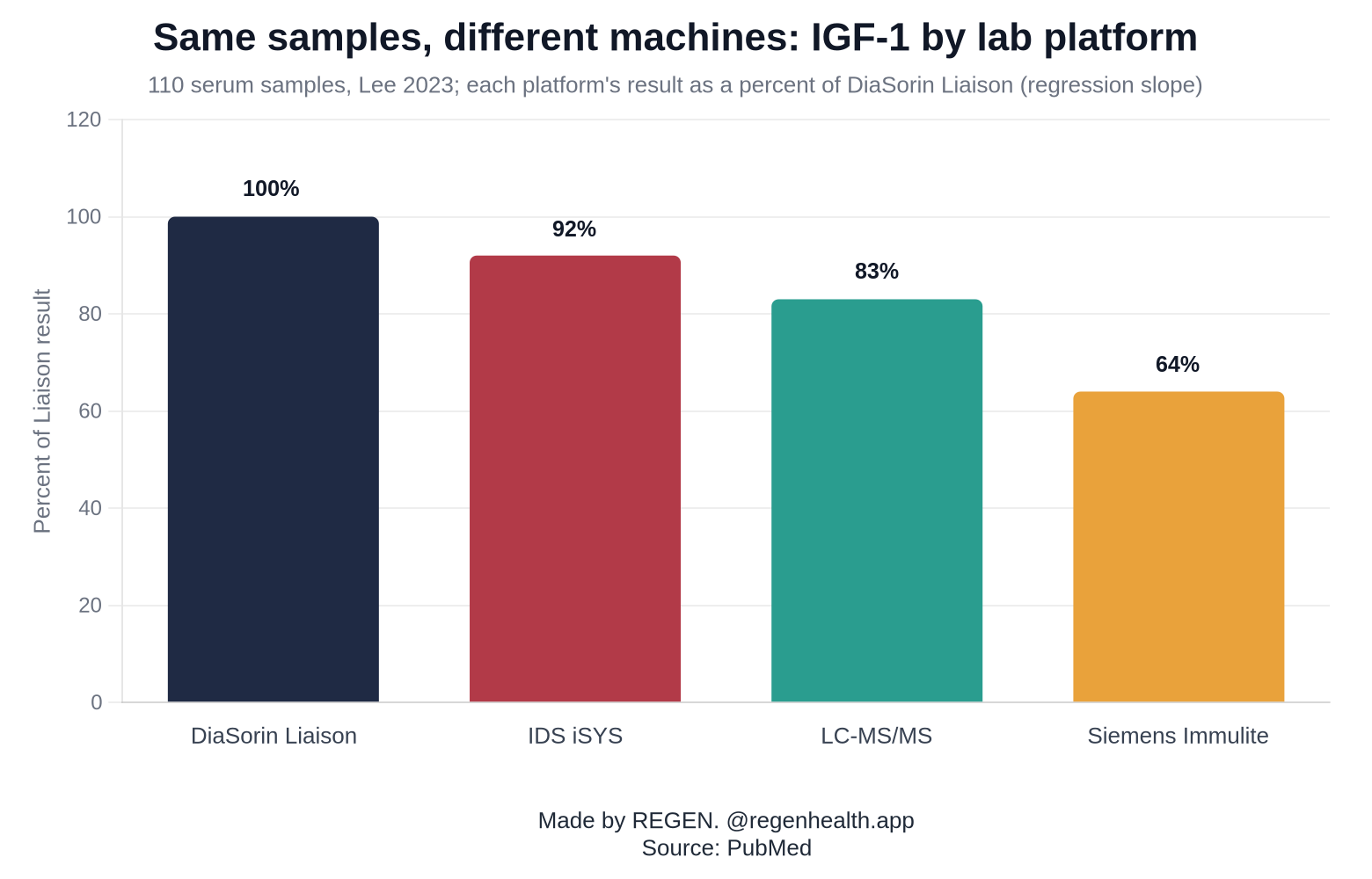
Different lab machines can report different IGF-1 values for the same blood sample. A 2023 study measured 110 serum specimens on four platforms and found approximately 36% negative variation on Siemens Immulite compared with DiaSorin Liaison.
Compared with Liaison, the same samples read about 8% lower on IDS iSYS and about 17% lower on LC-MS/MS, a mass-spectrometry method. The authors concluded that overall agreement between different platforms was poor and that the variation between platforms increased as IGF-1 values increased.
04 — Why labs still disagree
Representatives of the Growth Hormone Research Society, the IGF Society and the IFCC convened an international workshop on how growth hormone and IGF-I are measured. Their consensus statement concludes that major improvements are necessary in the areas of assay performance and comparability.
The workshop gave special attention to preanalytical conditions, meaning how a sample is collected and handled before it is tested, and to interference by binding proteins. For IGF-I it recommended normative data by age range, with consideration of Tanner staging, which describes stage of puberty, and of body mass index.
05 — What a low IGF-1 result does not prove
An IGF-1 result on its own does not establish adult growth hormone deficiency. The Endocrine Society's clinical practice guideline states that confirmation through stimulation testing is usually required unless there is a proven genetic or structural lesion persistent from childhood.
A stimulation test checks how much growth hormone the body releases in response to a specific trigger under medical supervision. The guideline also notes that growth hormone deficiency can persist from childhood or be newly acquired in adulthood, which is part of why the diagnosis involves more than one blood value.
06 — Comparing IGF-1 results over time
For repeat tests, the 2009 review notes that a high degree of methodological consistency in the assay is essential for long-term monitoring of individual patients. Because platforms can disagree, a change between two results is easiest to read when both came from the same lab method.
REGEN lets you upload bloodwork and see biomarkers such as IGF-1 as a trend line over time, with values outside the reference range flagged. The library pages for growth-hormone-related compounds such as tesamorelin and sermorelin summarize the published research on each one, and the how we grade page explains how that evidence is rated.
FAQ
What does an IGF-1 test measure?
It measures insulin-like growth factor I in a blood serum sample. A 2009 review explains that it is used to diagnose growth hormone deficiency and acromegaly and to monitor acromegaly treatment.
What is a normal IGF-1 level?
There is no single normal number. Ranges depend on age, sex and the specific assay. A 2014 study of 15,014 people found levels highest around age 15 and declining continuously later in life.
Why do IGF-1 results differ between labs?
Lab platforms measure IGF-1 differently. A 2023 study of 110 samples found Siemens Immulite read about 36% lower than DiaSorin Liaison, and agreement between platforms was poor.
Does a low IGF-1 test confirm growth hormone deficiency?
Not on its own. The Endocrine Society guideline says adult growth hormone deficiency usually needs confirmation through stimulation testing unless there is a proven genetic or structural lesion persistent from childhood.