Eloralintide vs Retatrutide: Efficacy and Tolerance
Evaluating eloralintide vs retatrutide requires moving beyond total weight reduction percentages to understand how peak systemic exposure aligns with gastrointestinal tolerance. Both compounds remain strictly experimental and are not FDA-approved for human use.
01 — The amylin agonist pathway
Eloralintide functions as an experimental high-potency amylin analog, differentiating its physiological mechanism from compounds targeting the glucagon-like peptide-1 receptor. In diet-induced obese rats, eloralintide administration resulted in a dose-dependent reduction in food intake and body weight, with weight loss driven primarily by fat mass loss. This mechanism contrasts with broader multi-receptor approaches like tri-agonism. Understanding this physiological pathway requires recognizing that eloralintide is not FDA-approved for human use; sold for research purposes only. The focus remains on evaluating how specific receptor agonism alters metabolic baselines in controlled environments. Researchers measuring these variables must distinguish between total body mass reduction and targeted adipose tissue loss, as amylin analogs specifically shift this physiological ratio.
02 — Tolerance to efficacy framework
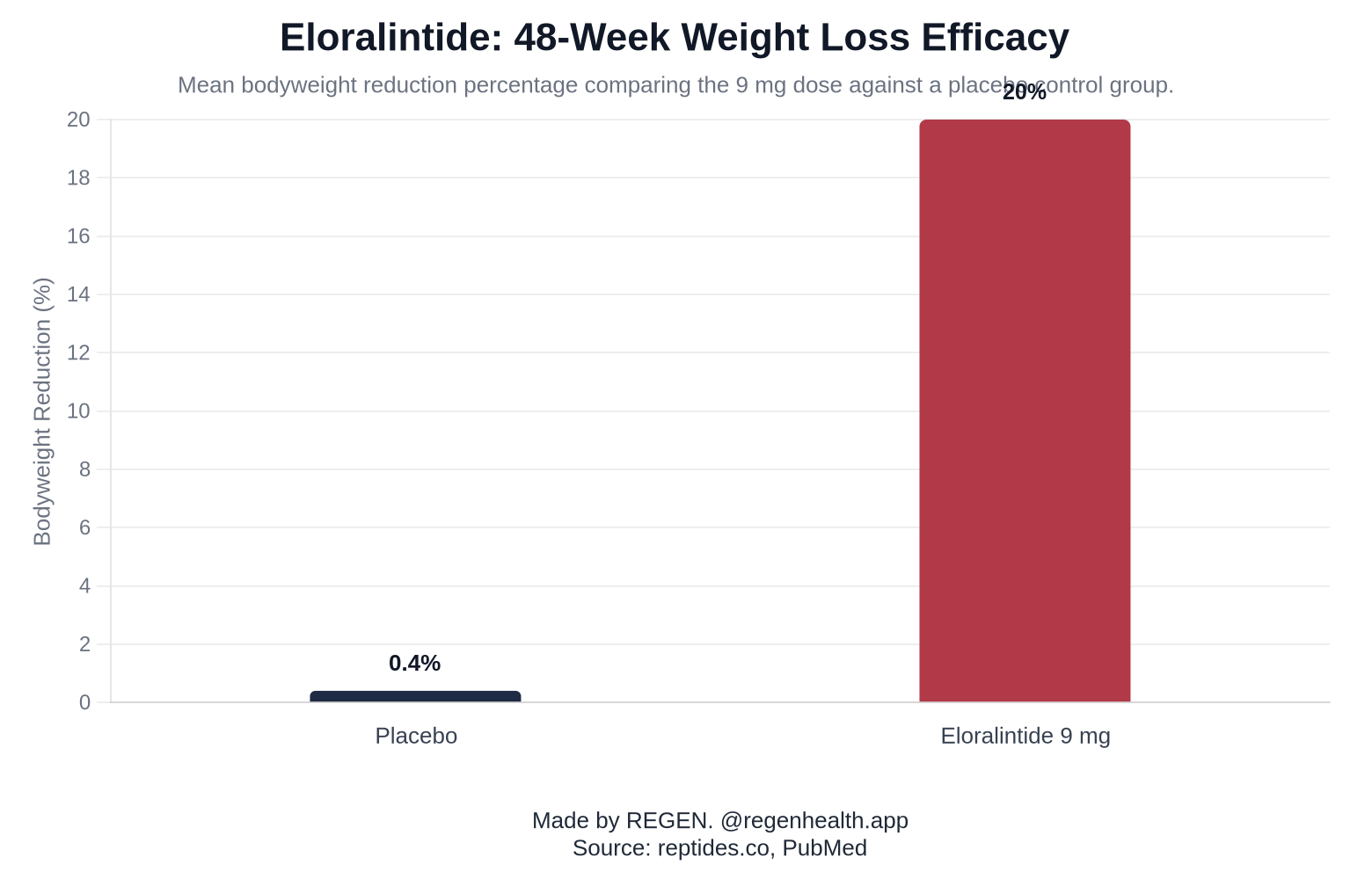
Clinical evaluation of experimental peptides necessitates mapping pharmacokinetic data against gastrointestinal tolerance. In a 12-week multiple ascending dose study, eloralintide exhibited dose-proportional pharmacokinetics, with AUCτ,ss and Cmax having dose-normalized geometric mean ratios of 1.1 and 1.0, respectively. Researchers must correlate these AUC-driven peak levels with baseline gastric emptying rates to mitigate emetic spikes. Treating these compounds as interchangeable interventions ignores the physiological reality of their distinct pharmacokinetic profiles. Effective research protocols require matching the peptide dose to specific tolerance markers rather than exclusively tracking weight reduction metrics. Managing the concentration curve ensures that gastrointestinal side effects do not prematurely terminate longitudinal evaluation.
03 — Eloralintide vs retatrutide side by side
Comparing eloralintide vs retatrutide requires an explicit evaluation of their distinct mechanisms, clinical evidence bases, and regulatory statuses as seen in the Emerging Role of GLP-1 Agonists in Obesity: A Comprehensive Review of Randomised Controlled Trials. The following dimensions illustrate how these experimental compounds differ in physiological application and metabolic measurement.
- Mechanism: Eloralintide acts as an amylin agonist demonstrating fat mass loss in rodent models, whereas retatrutide operates as a GLP-1, GIP, and glucagon receptor tri-agonist in clinical obesity trials.
- Evidence base: Eloralintide relies heavily on early-phase pharmacokinetic data such as a 12-week multiple ascending dose study in human subjects, while retatrutide evaluation includes broader randomized controlled trials for obesity.
- Regulatory status: Eloralintide is not FDA-approved for human use and is sold for research purposes only, whereas retatrutide is currently an investigational drug in late-stage clinical trials but also lacks FDA approval.
- Measurement differences: Eloralintide research prioritizes tracking AUC-driven peak systemic exposure to anticipate emetic spikes, while retatrutide protocols frequently monitor broad metabolic panel shifts typical of multi-receptor agonists.
04 — Gastrointestinal adverse effects
High-potency amylin interventions present significant gastrointestinal challenges during the titration phase. Nausea and vomiting rates frequently dictate the maximum tolerable threshold for experimental administration. Managing these emetic spikes requires precise calculation of the caloric floor and the hydration-to-fat-mass-loss ratio. Subjects demonstrating high baseline GLP-1 or PYY sensitivity may exhibit varied emetic responses to peak systemic exposure. Systematic reviews covering the Efficacy and Safety of Glucagon-Like Peptide-1 Receptor Agonists for Weight Loss Among Adults Without Diabetes : A Systematic Review of Randomized Controlled Trials. highlight that gastrointestinal events remain a primary limiting factor for metabolic interventions. Researchers must establish rigorous gut-health management protocols to maintain adherence during early dose escalation, including monitoring the volume and frequency of nutrient intake to prevent stagnation.
05 — Evaluating cardiovascular outcomes
Beyond isolated weight reduction, the evaluation of experimental metabolic compounds increasingly incorporates long-term cardiovascular and renal metrics. The precedent set by established incretin therapies provides a framework for these assessments. For example, researchers frequently reference the SELECT trial: semaglutide's cardiovascular benefit extends to kidney outcomes to model potential secondary endpoints for novel peptides. The theoretical cardiovascular profile of eloralintide remains under investigation, requiring extensive longitudinal data to draw definitive conclusions regarding broader systemic impact.
06 — Preparing research compounds
Handling experimental peptides necessitates exact formulation practices to ensure dose-proportional pharmacokinetics remain valid in laboratory settings. Achieving the consistent Cmax values observed in clinical data requires precise solvent ratios and sterile handling environments. Researchers often rely on standardized Reconstitution math, without the anxiety of miscalculating microgram concentrations. Maintaining the integrity of the lyophilized compound prevents degradation that could artificially alter physiological responses or exacerbate gastrointestinal side effects. Accurate preparation remains a fundamental prerequisite for reproducing the dose-dependent efficacy documented in published literature.
07 — Systemic tools versus isolated metrics
Evaluating eloralintide strictly through the lens of total body mass reduction fundamentally misrepresents its pharmacological profile. The compound functions as a highly specific systemic tool requiring careful alignment with individual metabolic baselines. Navigating the titration phase demands continuous assessment of gastric emptying and hydration status. Success in experimental models depends on matching the administered dose to the subject personalized tolerance profile rather than pursuing the highest theoretical efficacy percentage. This comprehensive physiological approach separates rigorous scientific inquiry from simplistic metabolic tracking. Integrating precise pharmacokinetic data ensures that peak serum concentrations do not overwhelm the gastrointestinal tract, preserving the viability of the long-term research model.
FAQ
How does Eloralintide work?
It operates by altering gastric emptying and satiety signals, though it remains strictly for research purposes.
What works faster, tirzepatide or retatrutide?
Retatrutide typically demonstrates more rapid weight reduction in clinical trials due to its triple-agonist action on GLP-1, GIP, and glucagon receptors compared to the dual-agonist mechanism of tirzepatide. Both compounds are currently evaluated in ongoing longitudinal studies to map their precise pharmacokinetic timelines.
Is Eloralintide a GLP-1?
No, eloralintide is not a GLP-1 receptor agonist; it functions primarily through the amylin agonist pathway to influence metabolic baselines and gastric emptying. This distinct mechanism separates it from traditional incretin-based interventions.
When will Eloralintide be available?
Eloralintide does not have an established timeline for commercial availability or FDA approval. It remains exclusively an experimental compound utilized in controlled research environments and is not cleared for human consumption.