What is Alpha-GPC Used For? Clinical Efficacy Data
Alpha-glycerophosphocholine is an acetylcholine precursor investigated primarily for its application in neuro-pathological populations. Rather than operating as an acute intervention, it relies on extended administration timelines to alter measurable outcomes in clinical psychometric assessments. Research systematically tracks these shifts in patients recovering from stroke, transient ischemic attacks, and vascular dementia to quantify cognitive changes.
01 — Clinical use and psychometric assessment
Alpha-GPC is used clinically and experimentally to evaluate cognitive changes in individuals facing neurological deficits. Medical research structures these evaluations around formalized scoring systems, measuring orientation, memory registration, and motor capability over extended cycles. The compound is not FDA-approved for the treatment of any medical condition, and researchers observe its effects strictly through standardized tracking methodologies.
Clinical trials do not assess generalized cognitive states; instead, they rely on specific endpoints like the Mathew Scale and the Mini-Mental State Test (MMST). By utilizing structured psychometric tests, investigators establish a baseline before administration and measure exact point deviations at intervals spanning 28 to 150 days. This approach separates measured neurological responses from unquantifiable subjective reports.
02 — Cholinergic activity in amnesia models
In neurological research, Alpha-GPC serves as a substrate for the synthesis of acetylcholine, a primary neurotransmitter involved in memory consolidation and attention. Investigators regularly induce cholinergic deficits in laboratory models to test the specific functional capacity of precursor compounds.
Researchers investigate this mechanism by observing the effect of a new cognition enhancer, alpha-glycerylphosphorylcholine, on scopolamine-induced amnesia and brain acetylcholine in controlled laboratory environments. Scopolamine is an anticholinergic agent that competitively blocks muscarinic receptors, creating a temporary state of profound memory impairment. Evaluating Alpha-GPC against this established model isolates its capacity to cross the blood-brain barrier and facilitate neurotransmitter synthesis under extreme antagonistic pressure.
03 — Stroke recovery at 28 days
In acute recovery contexts, clinical tracking focuses on functional neurological restoration rather than subtle cognitive memory shifts. The Mathew Scale is a comprehensive neurological scoring system initially developed to standardize the measurement of stroke severity, evaluating mental status, cranial nerve integrity, motor responses, and sensory perception.
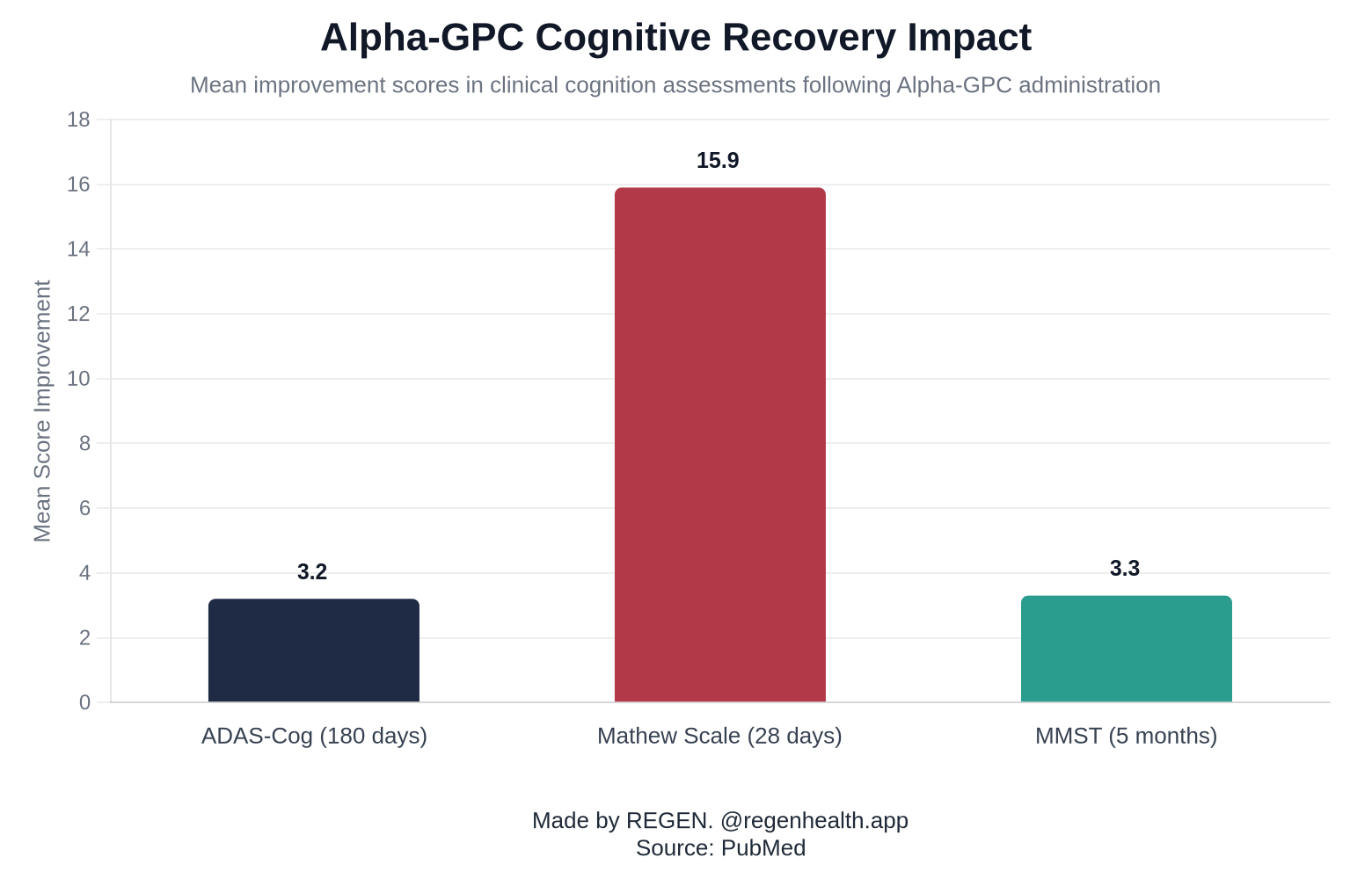
Clinical literature details a specific response interval following cerebrovascular events. In patients with recent stroke or TIA, Alpha-GPC administration resulted in a statistically significant increase in the Mathew Scale mean of 15.9 points (from 58.7 to 74.6) after 28 days. A shift of this magnitude represents a substantial clinical change in functional neurological capacity, establishing a clear division between baseline post-trauma impairment and subsequent post-intervention capabilities.
04 — Extended shifts in the MMST
Longitudinal evaluation requires tracking specific cognitive impairment markers over multiple months to confirm sustained neurological responses. The Mini-Mental State Test is a ubiquitous 30-point clinical questionnaire that screens for orientation, registration, attention, calculation, recall, and language capabilities. Moving from a baseline score of 21, which typically indicates mild to moderate cognitive impairment, to a higher threshold signifies a definitive measurable outcome.
Continuous daily administration protocols yield distinct data over these longer horizons. Following 5 months of oral Alpha-GPC, the MMST mean score increased from 21 to 24.3 (p < 0.001), with 71% of patients reaching 'no cognitive decline' or 'forgetfulness' on the GDS. The Global Deterioration Scale (GDS) categorizes the clinical progression of primary degenerative dementia. Reaching a categorized stage of mere forgetfulness on this scale indicates an alteration in the expected trajectory of cognitive decline over that specific five-month period.
05 — Alpha-GPC versus CDP-choline
Clinical researchers frequently compare different nootropic precursors to establish baseline efficacy expectations in structured trials. Cytosine diphosphocholine (CDP-choline) serves as a common benchmark in evaluations involving cerebrovascular disease and related cognitive impairment.
Comparative trial data isolates the distinct mechanisms of these two compounds in specific neuropathological populations. Alpha-GPC demonstrated statistically higher efficacy compared to cytosine diphosphocholine (CDP) across multiple psychometric tests in patients with vascular dementia over a 90-day period. This specific 90-day trial design provides researchers with sufficient duration to observe how differing choline sources influence neuroplasticity and cholinergic transmission across consecutive months of administration.
06 — Structured evaluation timelines
The clinical data dictates that psychometric variables require consistent testing over periods ranging from 28 to 150 days to register valid deviations. Acute interventions rarely yield changes on the Mathew Scale or the MMST; the documented results strictly follow multi-month administration cycles.
Similar to longitudinal observation protocols used for tissue recovery research involving TB-500, rigorous cognitive assessments require established baseline and follow-up intervals. Just as metabolic baselines are systematically recorded over months in clinical evaluations of Semaglutide, psychometric tracking demands strict adherence to structured intervals to evaluate the intervention. Efficacy is entirely dependent on whether variables exhibit measurable changes during these specific tracked assessment windows.
FAQ
What is Alpha-GPC used for?
Alpha-GPC is used clinically to investigate cognitive recovery and psychometric performance in populations with vascular dementia, transient ischemic attacks, and stroke. Researchers administer it over extended periods to track measurable changes on standardized tests like the Mathew Scale and the MMST.
What are the uses of acetylcholine in the body?
Acetylcholine is a primary neurotransmitter responsible for facilitating memory consolidation, attention, learning, and motor function. In clinical models, its synthesis is critical for evaluating cognitive decline and the efficacy of precursor compounds.
Does Alpha-GPC increase dopamine?
The primary clinical literature focuses on Alpha-GPC as a precursor for acetylcholine synthesis, and its direct long-term effects are measured through cholinergic pathways rather than primary dopaminergic activation.
Should I take Alpha-GPC daily?
Clinical protocols investigating Alpha-GPC for cognitive shifts rely entirely on daily, continuous administration spanning from 28 to 150 days. The compound is studied based on chronic exposure timelines rather than acute or intermittent application.
Is Alpha-GPC good for ADHD?
Alpha-GPC is not an approved treatment for ADHD, and the specific clinical data tracking its psychometric efficacy focuses almost exclusively on neuro-pathological decline, such as vascular dementia and post-stroke recovery.