Pramiracetam Dosage: Clinical Efficacy and Safety Profile
Pramiracetam is a synthetic compound investigated for its influence on cognitive deficits arising from neurological trauma or pharmacological induction. It is not FDA-approved for human use and is sold strictly for research purposes. Clinical evaluations emphasize precise pramiracetam dosage parameters, highlighting predictable pharmacokinetics and specific responses in episodic memory models.
01 — Clinical research and regulatory scope
As an investigational agent, pramiracetam is not FDA-approved for human use and remains restricted entirely to research and laboratory applications. The existing scientific literature focuses on defined clinical impairment models rather than general cognitive applications.
Research parameters prioritize establishing baseline safety and tolerability before observing any potential efficacy in impaired populations. Clinical trials focus intensely on populations experiencing documented cognitive deficits, such as those recovering from severe physical trauma or chemical induction. By observing these highly specific groups, researchers can document objective changes in memory recall and focused attention.
This strict methodological approach prevents broad generalizations and grounds the resulting findings in quantifiable neurological assessments. In clinical pharmacology, assessing physiological clearance markers is standard practice before administering investigational compounds. This ensures that the biological system can process and eliminate the substance efficiently, preventing systemic accumulation.
02 — Pharmacokinetic parameters and oral dosing
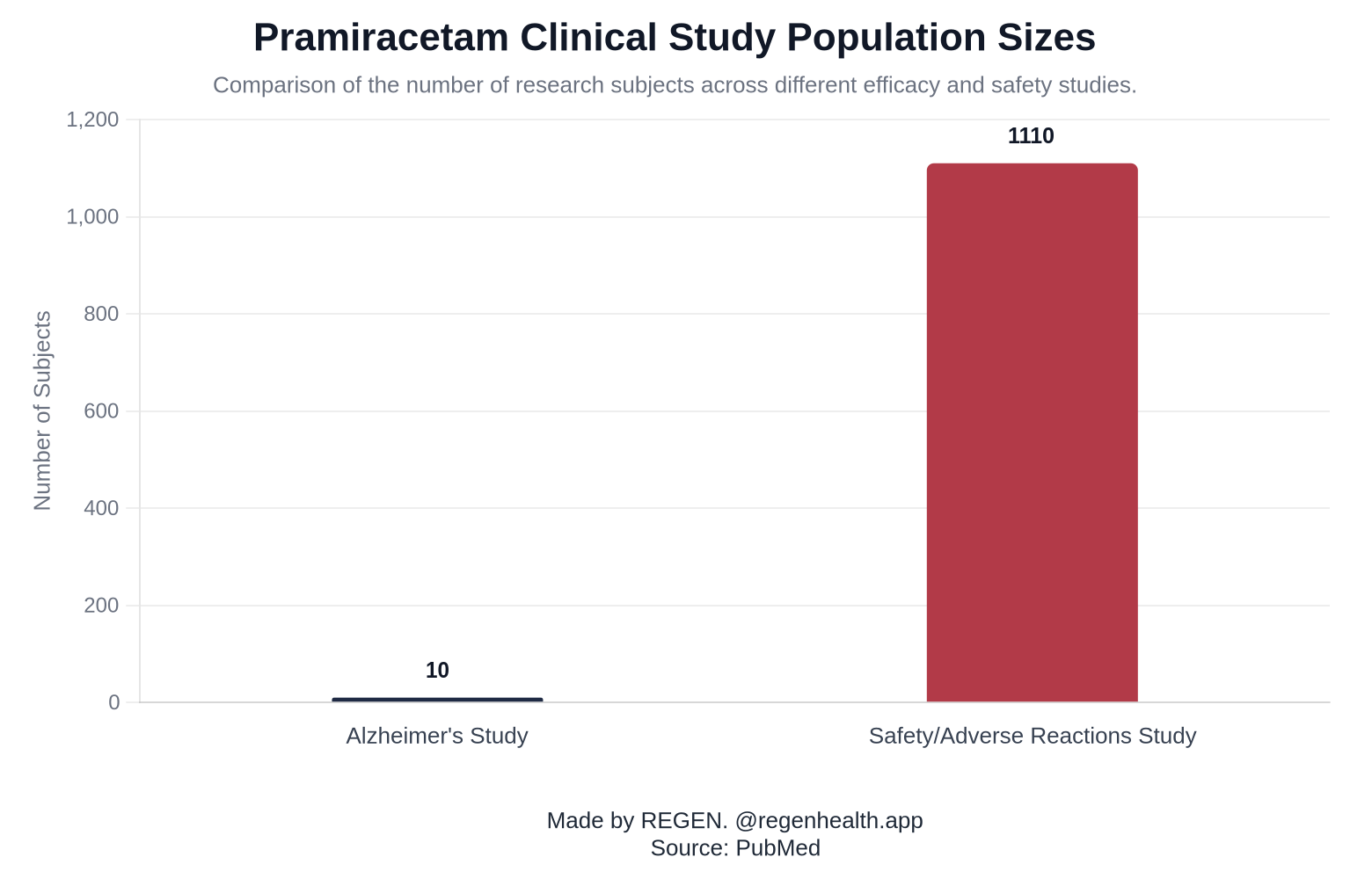
Pharmacokinetic evaluations are fundamental to determining appropriate dosing schedules in research settings. Single oral doses of pramiracetam (400 to 1,600 mg) showed linear pharmacokinetics and no significant side effects.
Understanding the pharmacological profile is a critical step in establishing safe administration protocols. Linear pharmacokinetics indicates that the rate of elimination remains proportional to the concentration of the substance within the system. This predictable relationship allows clinicians to calculate dosing increments mathematically.
The linearity observed across this wide milligram range provides researchers with highly predictable absorption and clearance models. Researchers utilize these single oral dose studies to structure subsequent multi-day trials. Establishing these foundational metrics ensures that subsequent observations of cognitive changes are based on a stable pharmacological presence in the body. Precise pharmacokinetic mapping remains the basis for determining a standard pramiracetam dosage in controlled laboratory environments.
03 — Assessing scopolamine induced deficits
Researchers frequently use pharmacological models to induce temporary cognitive impairments, establishing a baseline to test investigational compounds. Pramiracetam (600 mg BID for 10 days) partially reduced scopolamine-induced episodic memory and selective attention impairment in both young and old subjects.
Scopolamine is utilized in research to establish temporary cognitive deficits, creating a controlled environment to test interventions. Mitigating these specific deficits provides evidence of central nervous system activity. Observing these interactions in controlled clinical settings allows scientists to measure exact behavioral changes.
This trial design is crucial for isolating the exact behavioral changes caused by the compound. Episodic memory involves the ability to recall specific events, while selective attention requires maintaining focus amidst competing stimuli. By utilizing a 600 milligram twice-daily dosing schedule over a ten-day period, the researchers established a sustained systemic presence in the test subjects. The findings indicate that the compound interacts with the neurological pathways disrupted by scopolamine, presenting partial improvements in these targeted cognitive domains across varying age groups.
04 — Interventions for traumatic brain injuries
Clinical interest in this compound extends heavily into neurological rehabilitation, specifically focusing on deficits acquired through physical trauma. Pramiracetam has been reported to improve cognitive deficits associated with traumatic brain injuries.
Traumatic brain injuries create complex physiological recovery environments that require highly precise interventions. These cognitive deficits often manifest as prolonged difficulties with memory retention, spatial awareness, and basic information processing. Evaluating investigational compounds in these specific populations provides clearer data on rehabilitation potential. Other compounds like BPC-157 are frequently researched in parallel for their potential influence on physical tissue repair in traumatic models.
Researching traumatic brain injuries requires strict diagnostic criteria to ensure uniform subject populations. Assessments typically involve standardized neurocognitive batteries that measure processing speed, executive function, and working memory. Documenting functional recovery through these validated instruments ensures that the resulting data reflects true clinical improvements rather than temporary fluctuations in performance.
05 — Cognitive recovery following anoxia
Hypoxic events and severe physical trauma present significant challenges for long-term cognitive rehabilitation. Medical literature details a Placebo-controlled study of pramiracetam in young males with memory and cognitive problems resulting from head injury and anoxia.
Anoxic events often affect regions critical for memory consolidation. The inclusion of a placebo group in this specific demographic allows for highly controlled observations of cognitive recovery. Focusing strictly on young males with documented memory problems isolates the primary variable of the investigational compound.
Clinical trials targeting this type of injury require long-term observation to track structural and functional recovery. The data gathered from these specific models helps researchers understand physiological recovery following severe oxygen deprivation. This rigid methodology ensures that any observed improvements are directly attributable to the pharmacological intervention rather than spontaneous natural recovery.
06 — Biomarker monitoring in clinical trials
Investigating cognitive deficits requires overlapping evaluations of neurological function, metabolic health, and physiological clearance. Just as investigational peptides like Ipamorelin are studied for their systemic interactions, evaluating pramiracetam demands careful observation of baseline physiological health markers.
Monitoring biological responses during a trial ensures that researchers account for individual clearance rates and systemic variations. Clinical trials rely on comprehensive laboratory panels to track these physiological changes accurately over time. The integration of biomarker monitoring represents a shift toward precision in clinical research.
Rather than relying on generic guidelines, modern trials utilize biological data to observe systemic responses. Assessing metabolic panels and specific physiological responses provides a comprehensive view of how investigational protocols operate systemically. By connecting exact dosing schedules to specific biochemical recovery markers, research models maintain a high standard of objective evidence and clinical safety.
FAQ
What is the standard pramiracetam dosage in clinical trials?
In early human trials, single oral doses ranging from 400 to 1,600 mg were evaluated and showed linear pharmacokinetics. Subsequent multi-day research, such as models testing scopolamine-induced amnesia, utilized a schedule of 600 mg taken twice daily for ten days.
What are the primary pramiracetam effects observed in research?
Pramiracetam effects in clinical literature primarily involve partial reductions in episodic memory and selective attention impairments. These outcomes have been documented specifically in subjects experiencing deficits from traumatic brain injuries, anoxia, or pharmacological induction.
How does pramiracetam vs piracetam differ in clinical application?
While questions regarding pramiracetam vs piracetam are common in research settings, clinical data on pramiracetam distinctly focuses on its unique linear pharmacokinetics at doses of 400 to 1,600 mg. Studies specifically evaluate its application in targeted models like head injury and anoxia rather than direct comparative trials.