Nefiracetam and Oxiracetam: Clinical Efficacy Gaps
What is oxiracetam used for? Historically, oxiracetam was investigated as a pharmacological intervention for cognitive decline, but the compound is no longer actively prescribed. Its trajectory mirrors that of nefiracetam, with both compounds repeatedly failing to demonstrate statistically significant clinical benefits over placebo in late-stage human trials.
01 — The reality of legacy racetams
Despite frequent discussion in anecdotal forums, these legacy synthetic derivatives lack robust human efficacy data. Clinical evaluations have consistently shown that compounds in this class fail to meet the necessary pharmacological endpoints for cognitive health, leading developers and regulatory bodies to abandon them entirely in favor of validated interventions.
When evaluating the historical pharmacodynamics of these compounds, the gap between theoretical mechanisms in animal models and actual human outcomes becomes apparent. The entire racetam family has faced significant clinical friction in translating early hypotheses into measurable physiological changes. For example, exhaustive research into the foundational compound piracetam demonstrated no long-term benefits for the treatment of mild cognitive impairments. This lack of sustained efficacy established a pattern that subsequent derivatives, including oxiracetam and nefiracetam, were ultimately unable to overcome in controlled human testing environments.
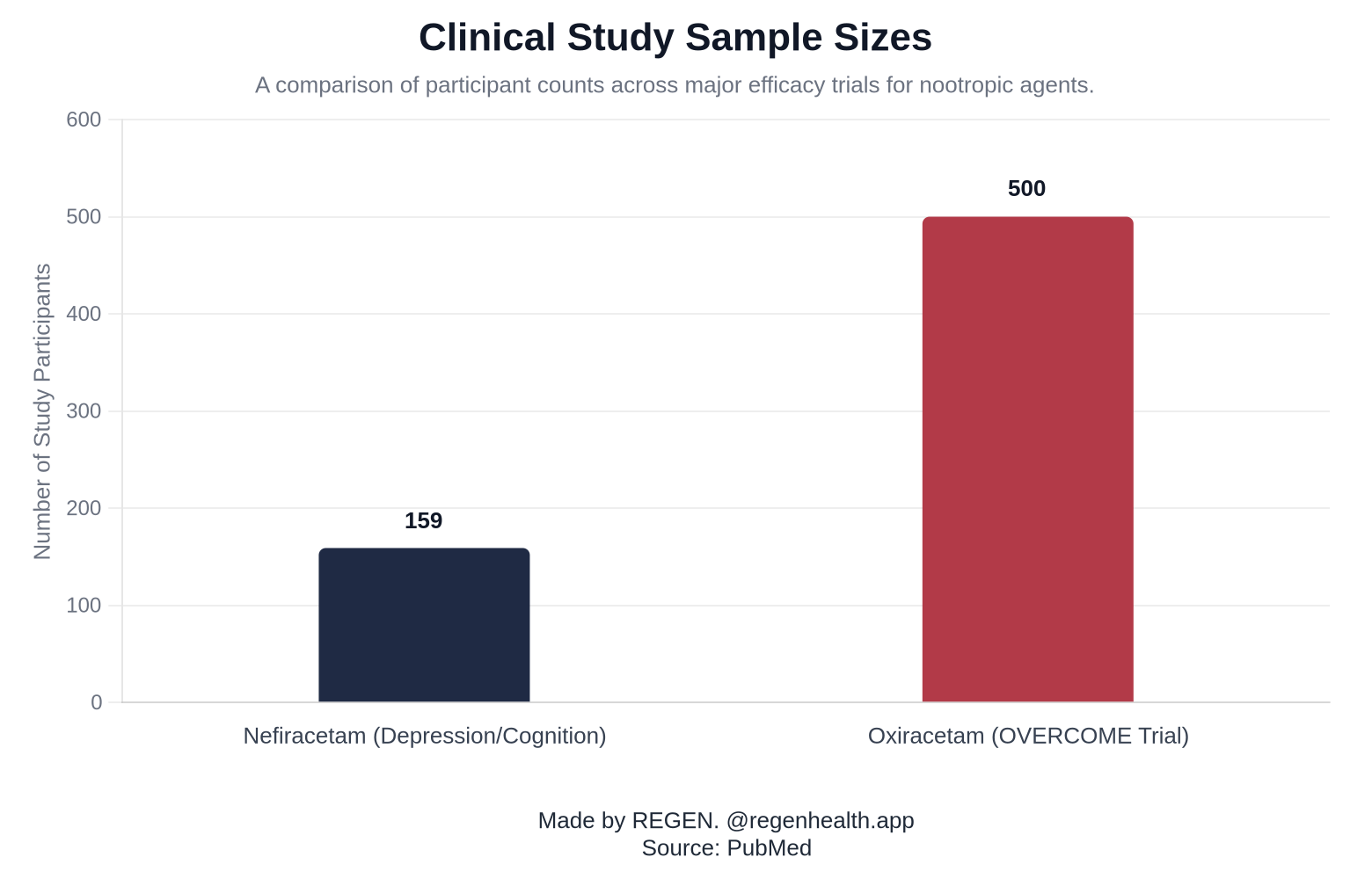
02 — Poststroke depression and apathy trials
Rigorous evaluations of nefiracetam for specific neurological recovery applications yielded unconvincing results in human trials. Placebo-controlled studies focusing on targeted functional outcomes post-infarction failed to establish the compound as a viable primary intervention, halting its progression into standard clinical neurological protocols.
Researchers actively attempted to validate nefiracetam through structured clinical models focusing on severe neurological deficits. A notable avenue of investigation was a double-blind randomized treatment of poststroke depression using nefiracetam, which sought to measure improvements in specific mood regulation metrics against a placebo baseline. Alongside these mood assessments, parallel research pursued functional engagement via a randomized, placebo-controlled, double-blind efficacy study of nefiracetam to treat poststroke apathy. Neither avenue provided the unequivocal data required to adopt the compound into standard stroke recovery guidelines. Instead of relying on unproven synthetic agents, specific therapeutic research often investigates established regenerative interventions; for instance, exploratory science frequently examines peptides like BPC-157 within tissue recovery models, though these also remain strictly in the research domain.
03 — Insufficient efficacy and NDA withdrawal
The failure of these compounds is documented clearly in international regulatory actions and corporate withdrawals. Pharmaceutical developers formally abandoned nefiracetam after it failed to meet necessary statistical thresholds in late-stage clinical evaluation, demonstrating a profound gap between preliminary theories and actual human efficacy.
The commercial history of nefiracetam provides a clear indication of its clinical viability. After extensive early-phase testing and preliminary investigations, the pharmaceutical manufacturer Daiichi withdrew its Japanese NDA for nefiracetam in 2002 due to insufficient efficacy in revised Phase III trials. A New Drug Application (NDA) represents the final regulatory hurdle before commercial medical availability; when a primary developer determines that the trial data cannot justify approval, the compound is effectively shelved. The clinical endpoints could not successfully separate the drug's physiological effect from a placebo response, rendering the commercial and medical application moot.
04 — Mild cognitive impairment data
Oxiracetam followed a similarly disappointing clinical trajectory regarding its primary proposed applications for cognitive decline. Due to repeated failures to alter disease progression or improve functional metrics in human subjects during rigorous testing, the compound was ultimately discarded by mainstream medical practitioners.
While early literature theorized potential mechanisms for altering cellular metabolism within the central nervous system, human outcomes remained persistently stagnant. Without verifiable improvements in measurable cognitive scores over longitudinal studies, medical systems formally discarded the intervention. The consensus in the medical literature firmly confirms that oxiracetam is no longer in clinical use. The continued existence of oxiracetam tablets or any purported oxiracetam supplement on international gray markets does not negate the fact that modern pharmacology has definitively abandoned the compound for the treatment of cognitive impairment.
05 — The shift to validated metabolic markers
Instead of pursuing abandoned synthetic compounds, contemporary medical approaches target verifiable physiological metrics. Biomarkers such as high-sensitivity C-reactive protein and detailed lipid profiles offer a measurable, evidence-based correlation with systemic and neurological health, providing a reliable framework for assessing physiological decline.
The pursuit of cognitive maintenance requires a foundation in metabolic reality rather than experimental historical derivatives. Chronic systemic inflammation and lipid dysregulation are recognized factors in physiological decline. Tracking these specific biological indicators provides a direct, measurable method for identifying health risks. Interventions must be anchored in demonstrable human efficacy. For example, specific metabolic targets are actively managed by clinically proven pharmacological tools; as an illustration, GLP-1 receptor agonists like Semaglutide operate via defined, extensively documented mechanisms for specific metabolic conditions, contrasting sharply with the failed clinical cycle and unproven status of legacy racetams.
06 — Why modern medical practice moved on
The scientific community requires unambiguous proof of functional improvement before maintaining an intervention in active clinical protocols. Nefiracetam and oxiracetam simply failed the gold-standard tests required for pharmacological adoption, cementing their status as historical footnotes rather than viable cognitive treatments.
Translating theoretical cellular mechanisms into consistent, statistically significant human outcomes is the primary barrier in neuropharmacology. The abandonment of these specific compounds was not an oversight; it was a deliberate, evidence-based response to the lack of clinical efficacy demonstrated in large-scale trial populations. Rather than continuing to investigate compounds that regulatory bodies and pharmaceutical developers have already discarded, standard medical practice demands reliance on interventions with proven therapeutic pathways. While focused basic research may continue to map distinct mechanisms using agents like TB-500 in localized tissue repair models, systemic cognitive interventions require the level of proof that these legacy racetams repeatedly failed to deliver.
FAQ
What are the benefits of taking oxiracetam?
There are no clinically proven benefits of taking oxiracetam, as human trials repeatedly failed to demonstrate significant improvements in cognitive function over a placebo. Because it failed to meet necessary statistical endpoints for the treatment of cognitive impairment, the compound was abandoned by pharmaceutical developers and is no longer used in standard medical practice.
Is oxiracetam safe?
Oxiracetam is not approved by the FDA for human use, meaning its long-term safety profile has not been validated through modern regulatory standards. Because clinical trials were abandoned due to a lack of efficacy, comprehensive data regarding its long-term physiological impact in large human populations remains incomplete.
What is the oxiracetam half-life?
Pharmacokinetic studies historically reported the half-life of oxiracetam to be approximately 8 hours in healthy human adults. However, because the compound lacks clinical efficacy and is no longer prescribed, understanding its half-life has little practical application for medical treatment.
Who should not take nootropics?
Individuals managing cognitive decline or systemic metabolic issues should avoid unproven synthetic nootropics in favor of clinically validated interventions. Legacy compounds like nefiracetam and oxiracetam failed late-stage clinical trials, and replacing targeted medical care with these abandoned experimental agents poses a risk to effective disease management.