GHK-Cu: What the Research Shows
GHK-Cu is a copper complex of GHK, a small human peptide discovered in 1973. Lab and animal studies report effects on collagen and tissue repair, but human evidence is limited: a 2026 systematic review found only 2 randomized trials among 20 studies.
01 — What GHK-Cu is
GHK-Cu is a copper complex of GHK, a small human peptide made of three amino acids. A 2012 review reports that the human tripeptide GHK was discovered in 1973 as an activity in human albumin that caused old human liver tissue to synthesize proteins like younger tissue.
The same review explains that GHK has high affinity for copper ions and easily forms a copper complex, which is the GHK-Cu form used in skin care research. The REGEN GHK-Cu library page summarizes the published research on the compound in one place.
02 — What lab and animal studies report
Most of what is known about GHK comes from laboratory and animal work. A 2018 review reports that GHK stimulates blood vessel and nerve outgrowth, increases collagen, elastin, and glycosaminoglycan synthesis, and supports the function of dermal fibroblasts, the cells that build the skin's support structure.
The same review says that, in the preclinical studies it summarizes, GHK's ability to improve tissue repair has been demonstrated for skin, lung connective tissue, bone, liver and stomach lining. It suggests that recent genetic data may explain these varied actions by revealing multiple biochemical pathways regulated by GHK.
03 — How much human evidence exists
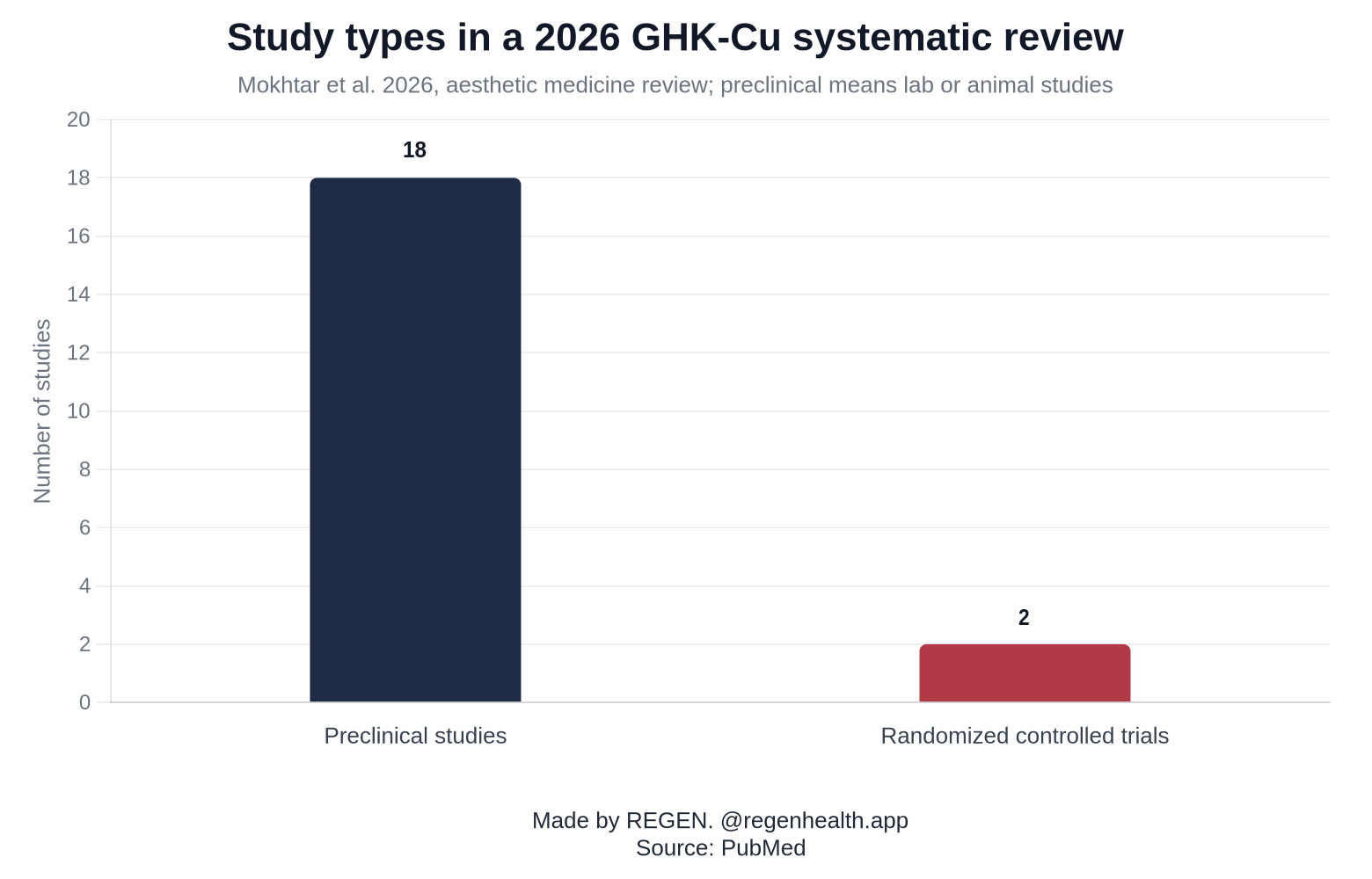
Human trial data on GHK-Cu are limited. A 2026 systematic review of GHK-Cu in aesthetic medicine included 20 studies, of which 18 were preclinical and 2 were randomized controlled trials.
In the clinical studies it reviewed, GHK-Cu improved patient-reported satisfaction after laser resurfacing and reduced wrinkle volume and depth compared with controls. The authors add that the findings were constrained by methodological variability and a limited number of well-designed trials. The REGEN GHK-Cu research page lists the individual studies.
04 — Who did most of the research
A second 2026 systematic review found that, despite more than four decades of preclinical evidence, the clinical literature in humans remains thin and fragmented. It reports that most randomized trials are small and conducted on facial cosmetic creams.
That review's conflict-of-interest statement adds that a large share of the primary GHK-Cu literature it covered includes Loren Pickart or Anna Margolina of Skin Biology Inc. as an author. Pickart first isolated the peptide, so much of the evidence comes from one research group tied to a skin-care company.
05 — GHK-Cu in skin care products
GHK-Cu is best known as a skin care ingredient. A 2025 review notes that GHK-Cu and Pal-GHK are widely used in anti-wrinkle products, yet the published information on their skin permeability and effectiveness is insufficient, and there is a surprising absence of clinical studies using them.
The review explains that these peptides are hard to formulate because they dissolve easily in water, which limits how well they pass through the outer layer of skin. It describes approaches such as metal complexation, chemical modification and skin pretreatment with microneedles that researchers have explored to improve skin permeation.
06 — Safety data and regulatory status
A 2026 sports medicine review examined approved and unapproved peptides marketed direct to patients, and GHK-Cu is one of the compounds it covers. It describes a parallel gray market of unapproved compounds operating largely outside of regulatory oversight.
The review reports that many unapproved peptides demonstrate favorable tissue repair and metabolic outcomes in animal models, but rigorous human safety data are scarce, and there is potential for serious harm to patients. The REGEN GHK-Cu side effects page collects what has been reported, and the how we grade page explains how the library rates this kind of evidence.
FAQ
What is GHK-Cu?
GHK-Cu is a copper complex of GHK, a small human peptide made of three amino acids. A 2012 review reports that GHK was discovered in 1973 in human albumin and readily binds copper.
What does GHK-Cu do?
In lab and animal studies, a 2018 review reports that GHK increases collagen, elastin and glycosaminoglycan synthesis and supports dermal fibroblasts. Human evidence is limited: a 2026 systematic review found 2 randomized controlled trials among 20 studies.
Is there human research on GHK-Cu?
Some, but not much. A 2026 systematic review says the human clinical literature is thin and fragmented, and that most randomized trials are small and tested facial cosmetic creams.
Is GHK-Cu safe?
Long-term safety is not well studied. A 2026 review of peptides marketed direct to patients, including GHK-Cu, says rigorous human safety data on unapproved peptides are scarce and notes potential for serious harm.