What Is Tirzepatide? What the Research Shows
Tirzepatide is a once-weekly peptide that activates two hormone receptors, GIP and GLP-1, instead of one. In the SURMOUNT-1 trial of 2,539 adults without diabetes, average weight change over 72 weeks was -15.0% to -20.9% on tirzepatide and -3.1% on placebo.
01 — What tirzepatide is
Tirzepatide is a once-weekly injectable peptide that acts on two hormone receptors at once: GIP (glucose-dependent insulinotropic polypeptide) and GLP-1 (glucagon-like peptide-1). Most earlier drugs in this class, such as semaglutide, act on the GLP-1 receptor alone. If you are new to the hormone itself, our explainer on what GLP-1 is covers the basics.
The REGEN tirzepatide library page collects the research on this compound and grades how strong it is. This post walks through the main human trials, one at a time, so you can see what each one actually measured.
02 — How it was developed
Tirzepatide began as a compound called LY3298176. A 2018 paper describing its discovery reported that it is a fatty acid modified peptide with dual GIP and GLP-1 receptor agonist activity, designed for once-weekly subcutaneous administration. In mice, it lowered body weight and food intake more than a GLP-1-only agonist did; those are animal results.
The same paper reported early human testing, in which 142 human subjects received at least one dose of LY3298176, dulaglutide or placebo. The main goal of that phase 1 work was safety and tolerability, and the most frequent side effects were gastrointestinal, dose-dependent and mostly mild to moderate.
03 — Weight results in adults without diabetes
SURMOUNT-1 was a 72-week phase 3 trial of 2,539 adults with obesity, or overweight plus a weight-related complication, who did not have diabetes. Average weight change was -15.0%, -19.5% and -20.9% across the three tirzepatide dose groups, compared with -3.1% on placebo within the same trial.
Gastrointestinal side effects were the most common, and most were mild to moderate and happened mainly while the dose was being increased. Adverse events led to stopping treatment in 4.3% to 7.1% of the tirzepatide groups and 2.6% of the placebo group.
04 — Blood sugar results in type 2 diabetes
SURPASS-2 was a 40-week open-label trial that randomized 1,879 adults with type 2 diabetes to tirzepatide or semaglutide. HbA1c, a three-month average of blood sugar, fell by 2.01 to 2.30 percentage points with tirzepatide and by 1.86 points with semaglutide, and tirzepatide was rated noninferior and superior at every dose tested.
Weight also fell more with tirzepatide in that trial, by an estimated 1.9 to 5.5 kg more than with semaglutide. Nausea was reported in 17% to 22% of the tirzepatide groups and 18% of the semaglutide group, and serious adverse events in 5% to 7% and 3%.
05 — Head-to-head with semaglutide for obesity
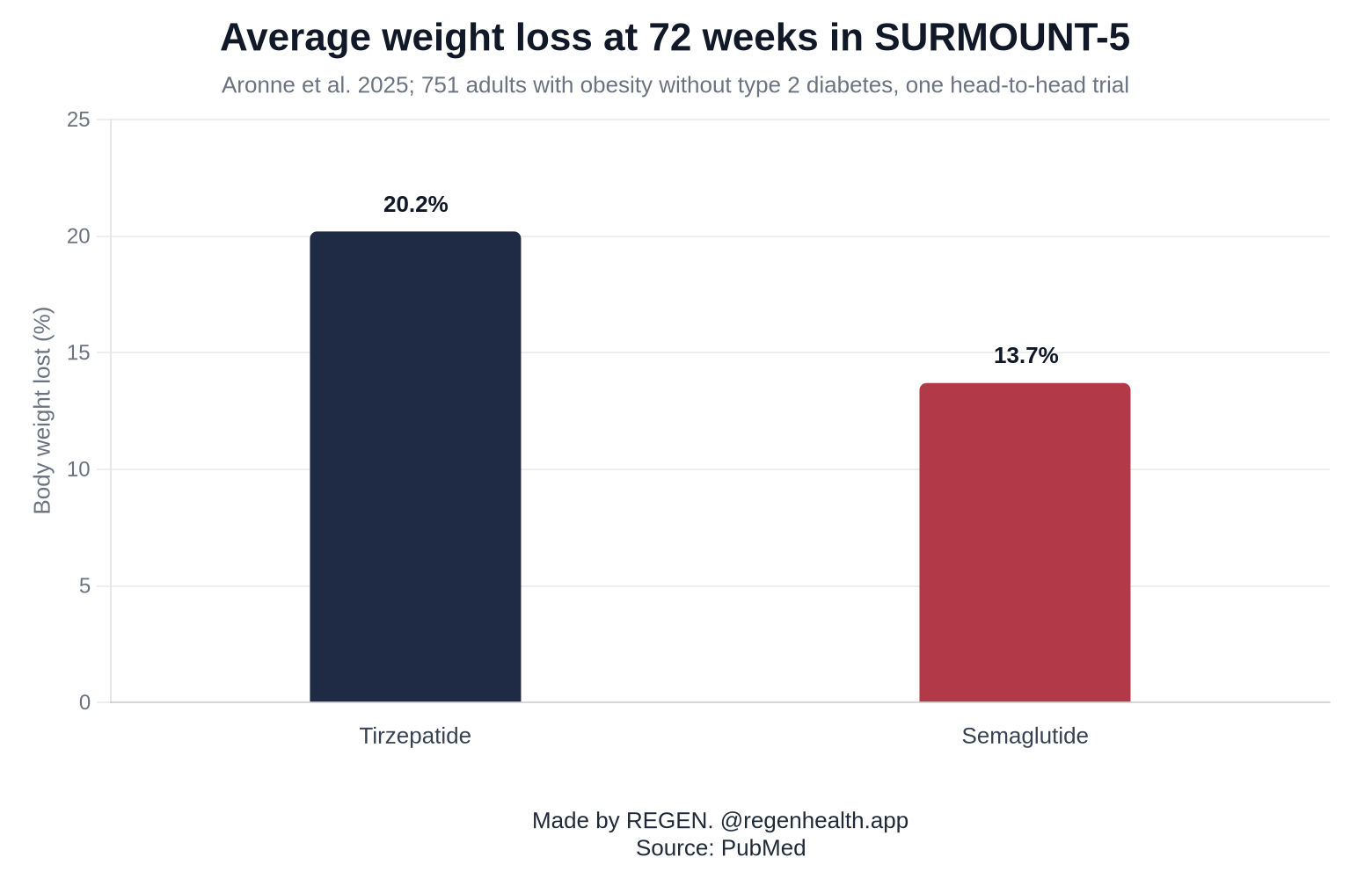
SURMOUNT-5 was a 72-week open-label trial that randomized 751 adults with obesity but without type 2 diabetes to the maximum tolerated dose of either tirzepatide or semaglutide. Average weight change was -20.2% with tirzepatide and -13.7% with semaglutide, and waist size changed by -18.4 cm and -13.0 cm.
In both groups the most common side effects were gastrointestinal, mostly mild to moderate and mainly during dose escalation. Because this was one trial comparing both drugs in the same population, it is a fairer comparison than setting results from separate trials side by side.
06 — What happened when it was stopped
SURMOUNT-4 tested what happens after treatment ends. All participants took tirzepatide for 36 weeks first, losing an average of 20.9% of their weight, and then 670 adults were randomly assigned to keep taking it or switch to placebo.
From week 36 to week 88, weight changed by -5.5% in the group that continued and +14.0% in the group switched to placebo. The authors concluded that withdrawing tirzepatide led to substantial regain of lost weight.
07 — Sleep apnea results
SURMOUNT-OSA was two 52-week phase 3 trials in adults with moderate-to-severe obstructive sleep apnea and obesity. Sleep apnea severity was measured with the apnea-hypopnea index (AHI), the number of breathing pauses or shallow breaths per hour of sleep, which averaged about 50 events per hour at the start.
In the trial of people not using a CPAP-style machine, AHI fell by 25.3 events per hour with tirzepatide and 5.3 with placebo; in the trial of people using one, it fell by 29.3 and 5.5. The most frequent side effects were gastrointestinal and mostly mild to moderate. How strong each finding is appears on the how we grade page.
FAQ
What is tirzepatide?
Tirzepatide is a once-weekly injectable peptide that activates both the GIP and GLP-1 receptors. It was developed as LY3298176 and has been tested in the SURPASS and SURMOUNT trial programs.
How is tirzepatide different from semaglutide?
Semaglutide acts on the GLP-1 receptor alone, while tirzepatide acts on both GIP and GLP-1 receptors. In the SURMOUNT-5 trial of 751 adults with obesity, average weight change was -20.2% with tirzepatide and -13.7% with semaglutide over 72 weeks.
How much weight did people lose in tirzepatide trials?
In SURMOUNT-1, a 72-week trial of 2,539 adults without diabetes, average weight change was -15.0% to -20.9% across tirzepatide dose groups and -3.1% on placebo.
What are the most common side effects of tirzepatide?
Across the trials, the most common side effects were gastrointestinal, such as nausea, and most were mild to moderate. In SURPASS-2, nausea was reported in 17% to 22% of people on tirzepatide.
What happened in trials when tirzepatide was stopped?
In SURMOUNT-4, people switched to placebo after 36 weeks of tirzepatide regained weight, +14.0% from week 36 to 88, while those who continued changed by -5.5%.