What Is GLP-1? What the Research Shows
GLP-1 is a gut hormone released after meals that stimulates insulin, holds back glucagon and appears to help regulate appetite. The body inactivates it within minutes, and medicines that act on its receptor were built to last longer; in the 68-week STEP 1 trial, adults on semaglutide had a mean weight change of -14.9% versus -2.4% on placebo.
01 — What GLP-1 is
GLP-1, short for glucagon-like peptide-1, is a hormone made in the gut. A 2007 review in Physiological Reviews describes it as a 30-amino acid peptide hormone produced in the intestinal epithelial endocrine L-cells, and notes that it is released in response to meal intake.
The same review lists its main actions: it stimulates insulin secretion, which makes it an incretin hormone, and it inhibits glucagon secretion. It also slows the movement of food through the gut and appears to be a physiological regulator of appetite and food intake. The REGEN semaglutide library page covers the most studied medicine that acts on this hormone's receptor.
02 — GLP-1 and appetite in a small study
A 1998 study tested whether GLP-1 changes how much people eat. In a randomized, blinded crossover design, 20 young, healthy, normal-weight men received an intravenous GLP-1 infusion on one test day and saline on another.
In that study, GLP-1 infusion enhanced satiety and fullness after breakfast and reduced spontaneous energy intake at an ad libitum lunch by 12% compared with saline. The participants were healthy men studied on single test days, so the result describes short-term appetite in a lab setting, not weight change over time.
03 — Why natural GLP-1 lasts only minutes
The 2007 review notes that GLP-1 is extremely rapidly metabolized and inactivated by an enzyme called dipeptidyl peptidase IV, usually shortened to DPP-4. That is a large part of why the body's own GLP-1 acts only briefly after a meal.
A 1995 study measured this breakdown in 8 healthy subjects and 8 patients with type 2 diabetes. During an intravenous infusion, intact GLP-1 accounted for only 19.9% of the rise in measured GLP-1 in the healthy subjects and 25.0% in the patients with diabetes; the remainder was a truncated metabolite.
04 — From Gila monster venom to longer-acting medicines
Because natural GLP-1 breaks down so fast, researchers looked for related molecules that last longer. A 1992 study reported that exendin-4, a 39-amino acid peptide, was isolated from the venom of the Gila monster, Heloderma suspectum. Exendin-4 is a different peptide from human GLP-1, and the REGEN exenatide library page covers the medicine and research that grew out of it.
Liraglutide is a GLP-1 analogue, a modified version of the hormone. In the 56-week SCALE trial of 3731 adults with obesity, or overweight with related conditions, and without type 2 diabetes, the once-daily liraglutide group had a mean weight loss of 8.4 kg versus 2.8 kg with placebo, and 63.2% versus 27.1% lost at least 5% of body weight. The REGEN liraglutide library page grades that evidence.
05 — What the semaglutide trials measured
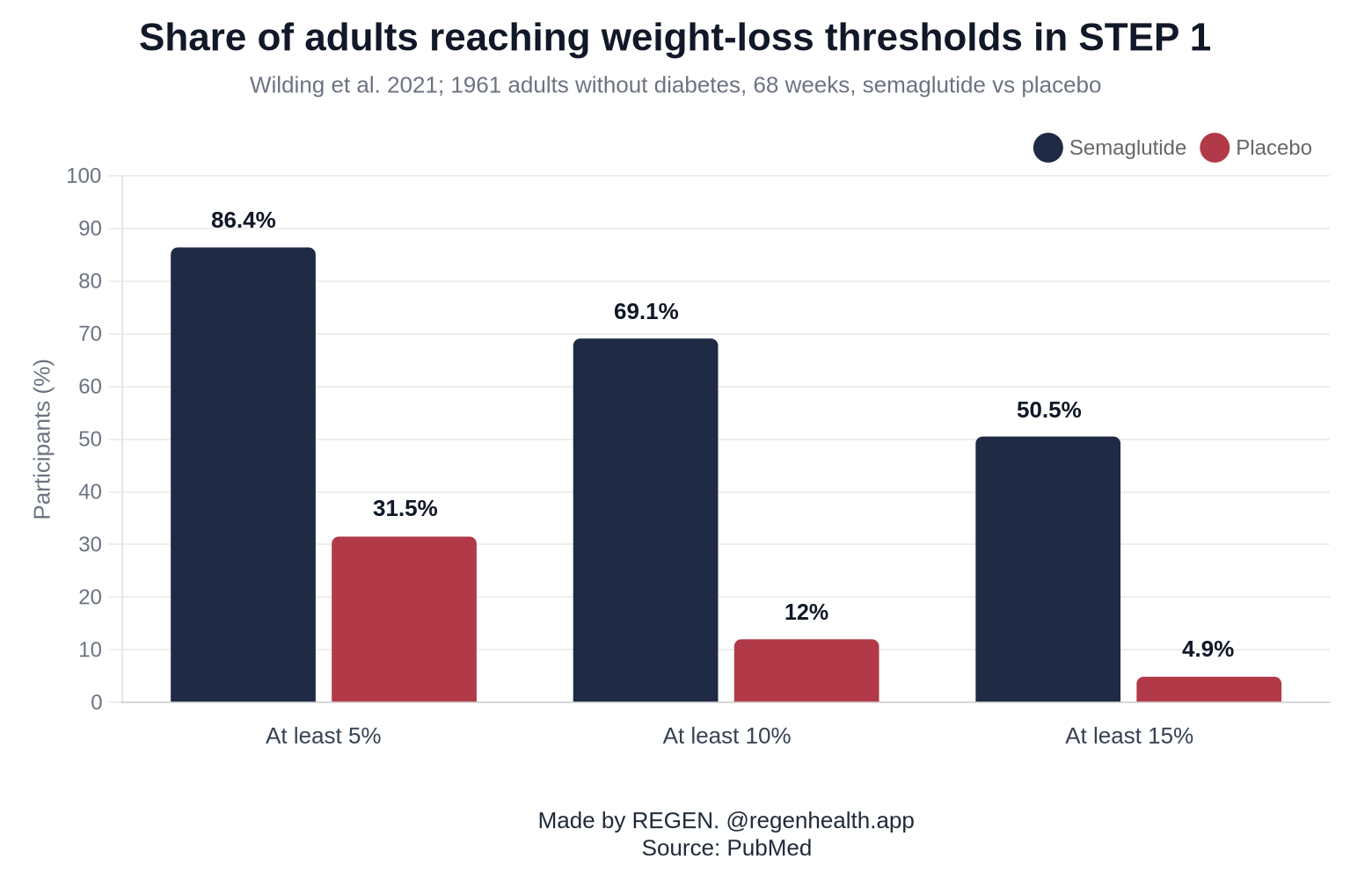
In the STEP 1 trial, 1961 adults with overweight or obesity and without diabetes were randomized to 68 weeks of once-weekly semaglutide or placebo, both alongside a lifestyle program. Mean body weight change was -14.9% with semaglutide and -2.4% with placebo. In the same trial, 86.4%, 69.1% and 50.5% of the semaglutide group lost at least 5%, 10% and 15% of body weight, compared with 31.5%, 12.0% and 4.9% of the placebo group.
SELECT asked a different question in a different population: 17,604 adults aged 45 or older with existing cardiovascular disease and overweight or obesity, but no diabetes. Over a mean follow-up of 39.8 months, the trial's primary cardiovascular end point (cardiovascular death, nonfatal heart attack or nonfatal stroke) occurred in 6.5% of the semaglutide group and 8.0% of the placebo group, a hazard ratio of 0.80.
06 — Side effects reported in the trials
The side effects reported for GLP-1 medicines are mostly digestive. In the SCALE trial of 3731 adults, the most frequently reported adverse events with liraglutide were mild or moderate nausea and diarrhea.
In STEP 1, nausea and diarrhea were the most common adverse events with semaglutide and were typically transient and mild-to-moderate. In that trial, 4.5% of the semaglutide group versus 0.8% of the placebo group discontinued treatment owing to gastrointestinal events.
In SELECT, adverse events leading to permanent discontinuation occurred in 16.6% of the semaglutide group and 8.2% of the placebo group. Each of these figures comes from its own trial and population, so they are not directly comparable with one another. The how we grade page explains how the REGEN Library rates evidence like this.
FAQ
What is GLP-1?
GLP-1 (glucagon-like peptide-1) is a 30-amino acid hormone made by L-cells in the gut and released after meals. A 2007 review describes it as an incretin hormone that stimulates insulin secretion and inhibits glucagon secretion.
What does GLP-1 do in the body?
According to a 2007 review, GLP-1 stimulates insulin release, inhibits glucagon, slows gut motility and appears to help regulate appetite. In a 1998 study of 20 healthy men, a GLP-1 infusion was followed by 12% lower energy intake at lunch than saline.
Why does natural GLP-1 wear off so quickly?
The enzyme DPP-4 rapidly inactivates it. In a 1995 study of 8 healthy subjects and 8 patients with type 2 diabetes, intact GLP-1 made up only 19.9% and 25.0% of the rise in measured GLP-1 during an infusion.
What are the most common side effects of GLP-1 medicines?
In the SCALE trial of liraglutide and the STEP 1 trial of semaglutide, nausea and diarrhea were the most common adverse events. In STEP 1 they were typically transient and mild-to-moderate.