What Happened to Bimagrumab? Clinical Trials vs Performance
Bimagrumab is an investigational compound developed to alter body composition and tissue metrics in human trials. It is not FDA-approved for human use, and clinical researchers study it exclusively in controlled experimental settings to evaluate its influence on complex metabolic parameters.
01 — The clinical trial parameters
Clinical development of the compound has centered on evaluating its ability to modify physical tissues in patients with specific health conditions. Researchers measure how the investigational drug alters measurable physical properties within the body over designated trial periods.
Medical investigators analyze these trial results to better understand the direct relationship between pharmacological tissue modification and practical human movement. Because it remains entirely experimental, investigators restrict its administration to rigorous trial protocols designed to capture precise clinical data without exposing general populations to unverified risks.
02 — Total fat mass shifts
In experimental settings involving adults with severe metabolic dysfunction, the compound demonstrated measurable shifts in specific bodily proportions. Researchers track these compositional changes to determine if targeted pharmacological interventions can effectively address specific tissue stores in vulnerable clinical demographics.
Formal clinical evaluations document these shifts in carefully selected patient populations experiencing systemic metabolic issues. Specifically, Bimagrumab treatment resulted in significant body composition changes, as the primary end point was the change in total body fat mass in adults with type 2 diabetes and obesity. By designing clinical trials around these distinct physical metrics, investigators gathered robust data on how the compound interacts directly with diseased metabolic states. Tracking these highly specific tissue compartments helps differentiate the compound from standard therapeutic pathways, such as medical interventions involving Semaglutide, emphasizing the ongoing clinical effort to address structural tissue imbalances rather than focusing exclusively on general body weight.
03 — Mobility in sarcopenia
Evaluating pharmacological treatments for age-related physical decline requires measuring actual physical movement, not just structural composition. Trial designs frequently use the Short Physical Performance Battery to quantify mobility, testing whether physiological tissue alterations translate to practical, mechanical capabilities in human patients.
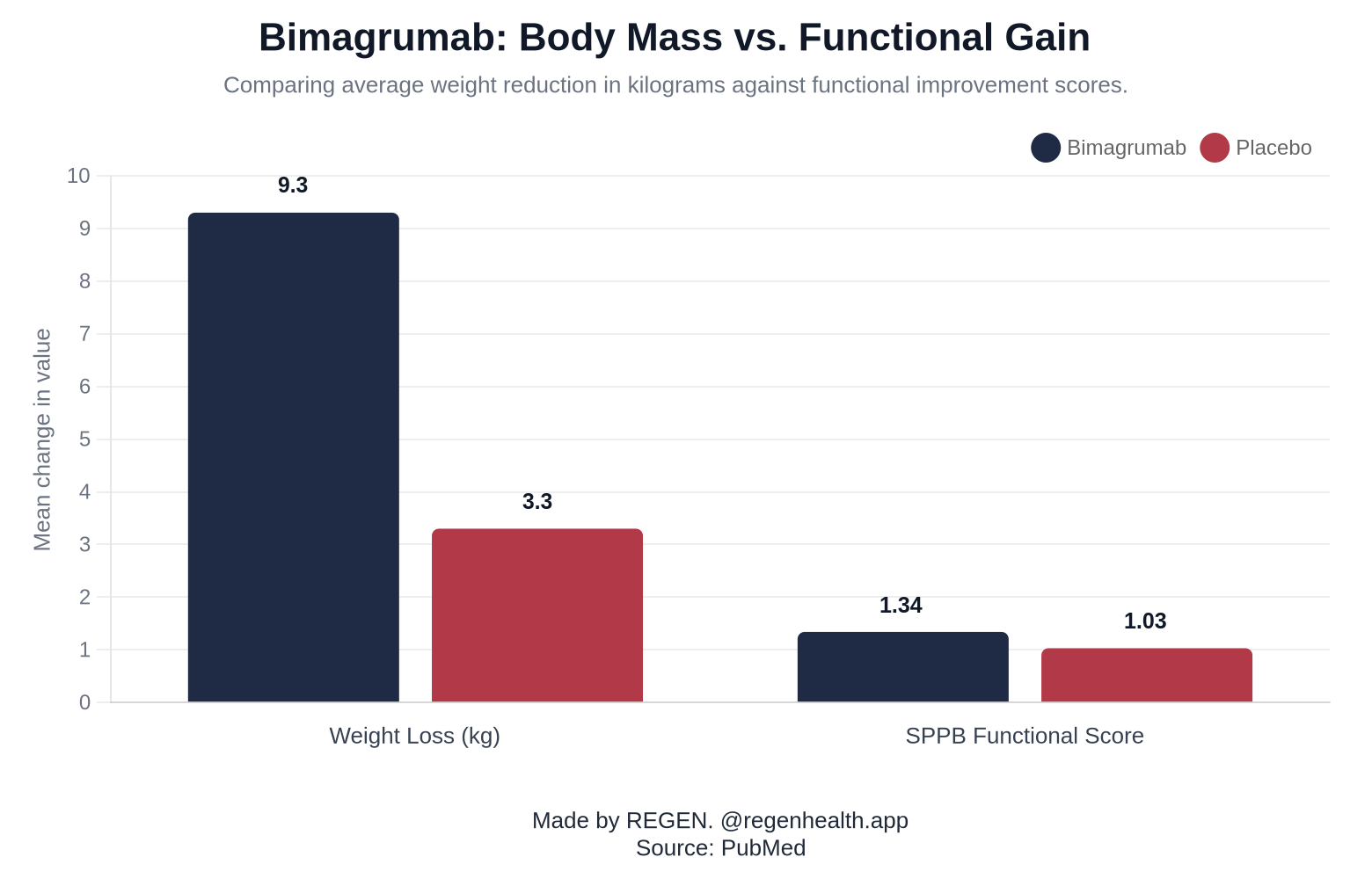
Generating measurable mechanical output remains a primary hurdle in clinical evaluations for physical decline. During demographic testing, Bimagrumab treatment failed to show a statistically significant improvement in SPPB scores compared to placebo (1.34 vs 1.03, P =.13) in older adults with sarcopenia. The SPPB test quantifies physical function through fundamental mobility tasks, proving that alterations in physical body composition do not automatically resolve the complex mechanical deficits experienced by aging populations. This specific clinical outcome confirms that treating functional mobility disorders requires generating actual mechanical force, not merely modifying the underlying structural framework of the body.
04 — Bimagrumab versus standard placebo
Assessing the practical utility of this investigational compound requires comparing its physical performance data directly against standard control groups. In sarcopenic populations, the controlled clinical data shows minimal functional separation between the active experimental treatment and inactive placebo administration.
- Physical Function (SPPB): Bimagrumab treatment failed to show a statistically significant improvement in SPPB scores compared to placebo (1.34 vs 1.03, P =.13) in older adults with sarcopenia.; Placebo administration separately yielded a 1.03 point baseline improvement during the same physical testing.
05 — Structural volume versus capability
Modifying physical body composition does not automatically produce stronger or faster human movement. The failure to achieve functional trial endpoints demonstrates that actual physiological capability depends on comprehensive neuromuscular function rather than relying on isolated physical tissue metrics alone.
Human biological systems require coordinated neurological signaling to translate structural changes into usable physical force. When an experimental compound influences fat or lean tissue compartments, the resulting physical state frequently lacks the organized mechanical motor recruitment required for complex daily tasks like walking or climbing stairs. Similar to how clinical researchers study distinct biological peptides like Ipamorelin to understand metabolic bodily pathways, investigators must strictly separate simple structural measurements from actual mechanical output. A physiological shift may appear distinctly on a laboratory scan, but without the corresponding mechanical output, the broader clinical application remains severely limited.
06 — Regulatory status restrictions
Bimagrumab is strictly an investigational compound and is not FDA-approved for human use in any capacity. The experimental drug remains restricted to clinical research settings where scientists closely monitor the long-term implications of artificially altering human body composition and physical mobility metrics.
Regulatory agencies strictly evaluate developmental compounds based on their ability to demonstrate clear, statistically significant benefits in patient function and overall safety. Because the pharmacological agent did not meet essential functional thresholds in specific older adult populations, it is not available for standard medical application or prescription. Its ongoing scientific evaluation is confined entirely to rigorous laboratory and clinical testing environments. Investigators continue to collect specific data on these experimental interventions to validate both basic safety profiles and practical mechanical efficacy before considering any potential commercial advancement.
FAQ
Is bimagrumab still being developed?
Yes, bimagrumab remains in clinical development as an investigational compound for metabolic and structural conditions. It is not FDA-approved for human use, and ongoing studies are restricted to controlled research environments to determine its long-term viability.
What is the success rate of bimagrumab?
Bimagrumab successfully reduced total body fat mass in specific trials for adults with type 2 diabetes and obesity. However, it failed to demonstrate a statistically significant improvement in functional mobility scores compared to standard placebo in sarcopenic patients.
How much does bimagrumab cost?
Bimagrumab is an investigational compound and is not available for commercial prescription or sale. Because it is strictly limited to formal clinical research, there is no standardized consumer or pharmacy pricing available.
Is bimagrumab safe?
Bimagrumab is not FDA-approved for human use, meaning a comprehensive safety profile has not been validated by regulatory bodies. Clinical investigators continue to evaluate its long-term physiological impact exclusively within structured research trials.