What is Semax Peptide Good For? BDNF & Neuroprotection
Semax is a synthetic peptide originally developed in Russia, heavily researched for its effects on brain-derived neurotrophic factor (BDNF) expression in rodent models. It is not FDA-approved for human use and is sold strictly for research purposes. Pharmacological interest centers on its ability to alter neurotrophin levels across distinct brain regions following intranasal administration.
01 — What the peptide actually does
Semax functions primarily by altering the expression of specific neurotrophic factors in central nervous system tissue. In controlled laboratory settings, researchers measure its pharmacological activity by tracking brain-derived neurotrophic factor (BDNF) mRNA and protein concentrations in rodent models following direct administration.
Unlike standard pharmacological agents that target neurotransmitter receptors directly, this peptide alters the gene expression of endogenous growth factors. Animal studies focus heavily on the hippocampus, a brain region central to memory and spatial navigation. Researchers utilize Semax nasal spray formats in these models to bypass gastrointestinal degradation, allowing the peptide to reach central nervous system tissues intact.
By tracking these specific mRNA transcripts, scientists can map the exact timeline of the peptide's onset and duration of action. The specific upregulation of BDNF provides a measurable biochemical marker for the peptide's activity, shifting the focus of investigation from subjective behavioral observations to quantifiable molecular changes. This rigorous tracking establishes a clear mechanism of action grounded in genetic transcription rather than generalized central nervous system arousal.
02 — Quantifying hippocampal protein changes
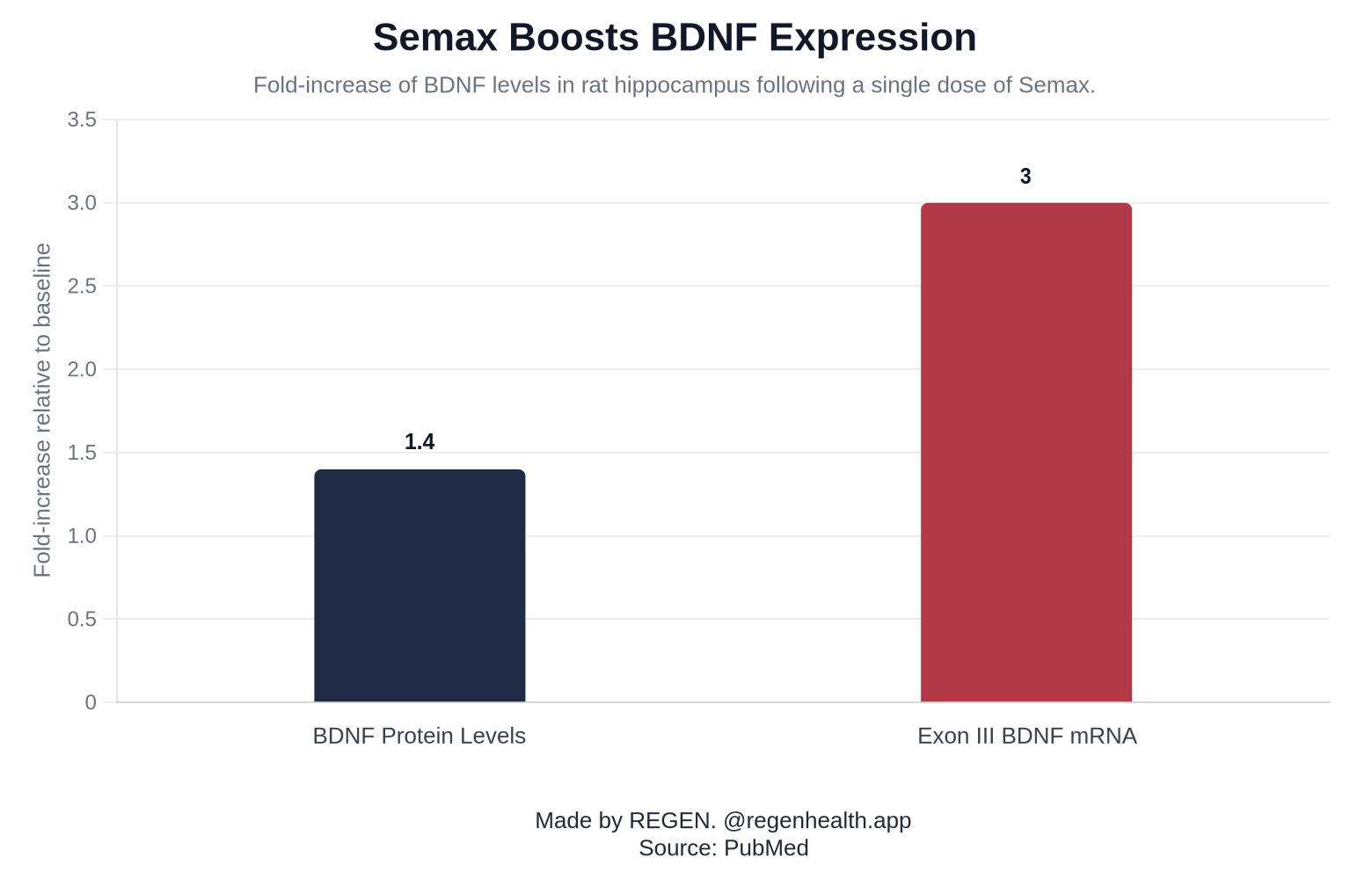
Experimental data demonstrates precise, dose-dependent increases in hippocampal markers following peptide exposure. A single intranasal application of Semax (50 microg/kg) results in a 1.4-fold increase in BDNF protein levels and a 3-fold increase in exon III BDNF mRNA levels in the rat hippocampus.
This distinct elevation highlights the compound's capacity to cross the blood-brain barrier in animal models and initiate transcription. The 3-fold increase in exon III BDNF mRNA indicates rapid genetic transcription, while the subsequent 1.4-fold increase in actual BDNF protein confirms that this mRNA is successfully translated into functional neurotrophins.
Such precise molecular tracking differentiates the pharmacological reality of the peptide from generalized claims of cognitive alteration. When the exogenous peptide binds, it triggers a signaling cascade that forces the cells to transcribe more of their own endogenous neuroprotective factors. Researchers specifically isolate these exact percentage folds to determine the dose-response curve, establishing how much of the peptide is required to achieve a statistically significant biological effect in mammalian tissue.
03 — Regional brainstem and cerebellar markers
The biochemical effects of the peptide extend beyond the hippocampus into other critical regulatory centers of the brain. Intranasal Semax administration led to a significant increase in BDNF gene expression in the rat hippocampus, brainstem, and cerebellum 1 hour post-application.
Observing gene expression changes in the brainstem and cerebellum indicates a widespread central nervous system distribution following intranasal delivery. The brainstem controls basic autonomic functions, while the cerebellum governs motor control and coordination. Identifying significant increases in these specific tissues at the 1-hour mark provides a temporal framework for the peptide's distribution and cellular uptake.
Readers exploring Selank vs Semax often look at these distinct regional activation profiles to understand differing research applications, as each peptide targets slightly different neurochemical pathways. The cerebellum's involvement suggests that the peptide may influence pathways related to fine motor coordination and spatial learning, while the brainstem activation points to fundamental autonomic regulation. This wide-ranging transcription activity requires careful measurement to isolate exactly which cellular populations respond most robustly to the compound.
04 — Retinal gene expression dynamics
The peptide's influence on specific neurotrophin expression also reaches specialized peripheral nervous system tissues, specifically the ocular structures. In the rat retina, BDNF gene expression levels were significantly increased 90 minutes following Semax administration, indicating a measurable systemic distribution profile.
The retina shares an embryonic origin with the brain, making it a critical site for neuroprotective research. The timeline observed here shows a slight delay compared to the 1-hour activation seen in the brainstem and cerebellum, illustrating the pharmacokinetic journey of the compound through different tissue barriers.
By upregulating BDNF in retinal tissue, the peptide demonstrates a capacity to influence structures susceptible to ischemic and oxidative damage. This specific finding forms the biological basis for ongoing investigations into the compound's broader capabilities across various central and peripheral neural networks. The ocular tissue serves as an accessible proxy for central nervous system health, allowing scientists to measure transcription rates without requiring invasive brain sampling in certain experimental setups.
05 — Neuroprotective research and human data
While animal models provide detailed timelines of gene expression, clinical data remains strictly limited. Literature assessing the Neuroprotective effects of peptides bioregulators in people of various age highlights theoretical potentials, but Semax itself lacks large-scale human efficacy trials and remains an unapproved experimental compound.
The translation of rodent pharmacokinetic data into human application requires rigorous clinical validation that is currently absent from Western regulatory frameworks. Researchers investigating compounds like BPC-157 frequently note that animal models of ischemia do not account for the complex comorbidities present in human cardiovascular disease. The existing literature highlights the biological feasibility of neurotrophic factor restoration in rats, but clinical protocols for stroke recovery or cognitive decline have not been established or approved by the FDA.
Consequently, all observed biochemical changes must be contextualized strictly within the parameters of controlled laboratory experiments rather than human medical treatments. The scientific gap between inducing mRNA translation in a controlled rodent environment and proving clinical efficacy in a human trial remains substantial.
06 — Administration and regulatory reality
Semax is administered intranasally in laboratory settings to facilitate direct central nervous system access, but it is not approved for medical use in the United States. The compound is strictly designated for research purposes and is not intended for human consumption.
The reliance on a nasal administration route in rat studies serves a specific scientific purpose: circumventing the digestive destruction that typically degrades peptide chains. Despite this specific laboratory methodology, the compound holds no FDA approval for any medical condition, cognitive or otherwise.
The lack of standardized human dosing guidelines, combined with the absence of long-term safety data, restricts its use entirely to preclinical research environments. Understanding the strict gap between measured BDNF mRNA spikes in rodent models and the legal, physiological reality of unapproved peptides is essential for accurately interpreting the existing scientific literature. Without Phase III clinical trials, any extrapolation of these rodent transcription rates to human cognitive or neurological outcomes remains unsupported by current medical consensus.
FAQ
Who should not take Semax?
Semax is not FDA-approved for human use and should not be taken by anyone outside of approved, heavily monitored clinical trials. It is legally designated strictly as a research chemical.
When should Semax be taken?
Because it is an unapproved research chemical, there is no established or medically approved timeframe for human administration. In laboratory studies, researchers administer it to rodents at specific intervals to measure resulting genetic transcription rates.
Does Semax act like a stimulant?
In rodent models, the compound alters neurotrophic factor expression rather than directly stimulating neurotransmitter release like classical amphetamines. Its mechanism of action relies on upregulating BDNF mRNA rather than forcing immediate central nervous system arousal.
What is Semax comparable to?
In preclinical research, it is most frequently compared to other experimental synthetic peptides like Selank. However, researchers note that these compounds target distinct regional gene expression profiles within the central nervous system.