Pharmacokinetic Profiles: CJC-1295 vs. Sermorelin
Pharmacokinetic profiles: CJC-1295 vs. Sermorelin contrast a multi-day sustained baseline against a brief endogenous pulse. CJC-1295 maintains elevated binding for over a week, whereas Sermorelin clears the bloodstream in minutes. Selecting the correct compound requires mapping specific molecular half-lives directly to physiological biomarker responses.
Architecture
CJC-1295 and Sermorelin possess fundamentally different molecular structures that dictate their operational half-lives. While Sermorelin acts rapidly to replicate a brief physiological pulse, CJC-1295 incorporates a specific complex to maintain a continuous presence, entirely bypassing pulsatile secretion and requiring strict metabolic tracking.
Evaluating these compounds means understanding the gap between a brief physiological pulse and a multi-day saturation phase. Sermorelin represents a shorter chain designed to clear the system quickly. Conversely, CJC-1295 modifies the chain by adding a Drug Affinity Complex, fundamentally altering how long the molecule remains active. It is critical to note that neither compound is approved for general metabolic application. Specifically, CJC-1295 is not FDA-approved for human use; sold for research purposes only.
Clearance
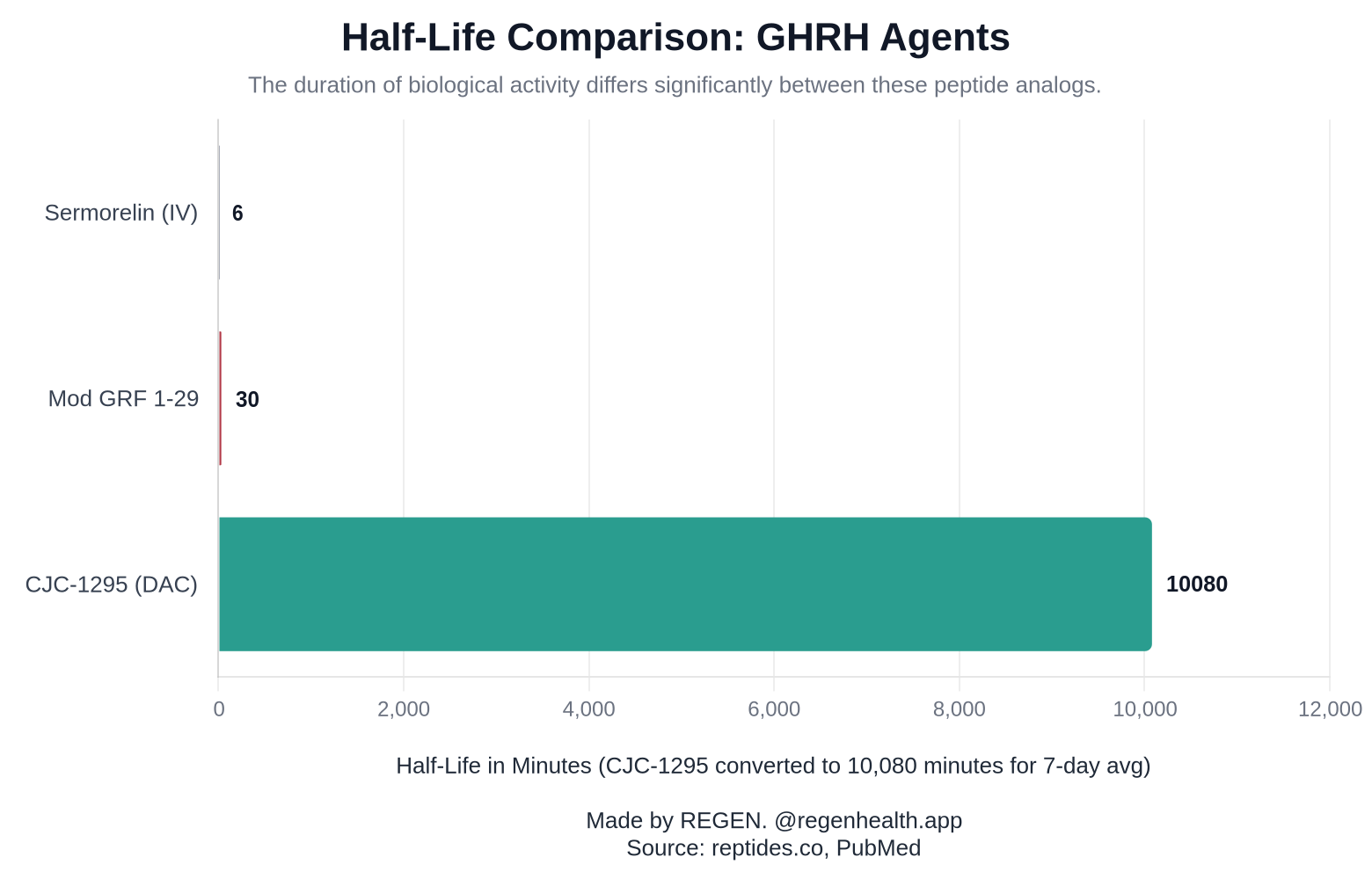
Sermorelin clears the human bloodstream in minutes, reflecting the rapid breakdown characteristics of native peptide hormones. In clinical evaluations measuring exact pharmacokinetic parameters, researchers quantified this rapid clearance rate to understand how briefly the peptide remains active before complete systemic elimination.
When assessing the clearance of shorter-acting peptides, precise pharmacokinetic measurements reveal exactly how fast the body metabolizes the compound. In clinical assessments evaluating human subjects, researchers documented that the disappearance half-time of D-Ala2-GHRH-(1-29) was 6.7 minutes, compared to 4.3 minutes for GHRH-(1-29)-NH2. These figures demonstrate the rapid nature of the pulsatile window. Additionally, the same study indicated that the metabolic clearance rate of the D-Ala2 analog was 21 mL/kg/min, significantly lower than the 39.7 mL/kg/min for GHRH-(1-29)-NH2.
Saturation
CJC-1295 utilizes a specific molecular complex to achieve a highly extended presence in circulation. Instead of clearing within minutes, the modified compound maintains elevated concentrations and exerts continuous physiological activity for more than a week following a single initial administration.
Applying a Drug Affinity Complex to the peptide chain changes the biological timeline entirely. By preventing rapid breakdown, the complex forces the body into a state of continuous exposure. In trials analyzing these prolonged effects in healthy adults, data showed that CJC-1295 has an estimated half-life of 5.8-8.1 days and increases IGF-I levels for 9-11 days after a single injection. This extended window bypasses normal pulsatile secretion entirely, forcing a sustained baseline elevation that demands careful clinical monitoring.
Biomarkers
Tracking the systemic divergence between these specific pharmacokinetic profiles requires precise monitoring of IGF-I concentrations. Because CJC-1295 produces prolonged elevation and Sermorelin induces only rapid spikes, observing blood biomarkers over a ten-day window determines whether the physiological response matches the structural intent.
Selecting the correct compound requires mapping the specific half-life directly to the IGF-I response. If the objective is to mimic an endogenous pattern, a short-acting compound dictates that IGF-I levels must be evaluated around the ten-day mark to confirm the body has not plateaued. Conversely, an extended half-life creates a constant baseline elevation. A failure to measure these biomarkers accurately means guessing whether the organism is experiencing anabolic growth or simply hitting a metabolic ceiling.
Modulation
Managing physiological responses to varied peptide half-lives requires precise observation of secondary metabolic markers. Sustained saturation from longer-acting compounds can shift baseline states, demanding strict tracking of fasting glucose and insulin sensitivity to ensure the body responds without experiencing systemic tachyphylaxis.
When baseline IGF-I remains elevated for an extended period, the body often exhibits secondary metabolic shifts. Prolonged systemic exposure can alter insulin sensitivity and fasting glucose levels, requiring rigorous observation to prevent over-stimulation. Similar to the targeted biomarker analysis applied with the KPV Tripeptide and Targeted Inflammatory Modulation, mapping the physiological downstream effects of long-acting peptides is necessary to verify the organism is tolerating the continuous metabolic pressure.
Dynamics
The choice between a short-acting pulse and long-acting saturation dictates the resulting metabolic rhythm. Rapid clearance allows physiological systems to return to baseline promptly, whereas sustained exposure maintains continuous activity without a natural refractory period, requiring rigorous and ongoing clinical measurement.
The primary differentiator between these compounds is not their respective potency, but rather the architectural implications of their metabolic timelines. A fast-clearing compound allows physiological systems to reset, honoring the natural refractory period of the organism. An extended saturation model provides continuous pressure, which may yield different long-term adaptations. Properly assessing these dynamics relies entirely on measuring specific blood markers against the known clearance rates of each respective compound.
Frequently asked questions
What is the primary difference in half-life between CJC-1295 and Sermorelin?
Sermorelin clears the bloodstream in minutes, mirroring a natural pulsatile release. In contrast, CJC-1295 incorporates a Drug Affinity Complex that extends its half-life to over a week, creating a continuous, sustained baseline elevation.
Why do researchers track fasting glucose when evaluating CJC-1295?
The prolonged saturation of CJC-1295 maintains elevated metabolic activity for over a week. This continuous exposure can impact insulin sensitivity and fasting glucose, necessitating careful monitoring to identify signs of metabolic over-stimulation.
Are CJC-1295 and Sermorelin FDA-approved for metabolic use?
Neither compound is approved for general metabolic application. CJC-1295 is not FDA-approved for human use; it is heavily utilized in clinical environments and sold exclusively for research purposes.